-
Colleges
-
Graduate School
- Graduate School
- Scout Grad School Search Find and compare grad schools based on your preferences, goals and academic interests.
- $5,000 Grad School No Essay Scholarship† Enter to win our $5,000 no essay grad school scholarship in 2 min or less.
- Graduate Degrees Explore graduate degree options that fit your goals.
- Paying for Graduate School Understand costs and explore ways to pay for grad school.
-
Scholarships
- Scholarships
- $2,000 No Essay Scholarship† Enter to win our no essay $2,000 college scholarship in 2 minutes or less.
- Scholly Scholarships Easily find and sort through thousands of college scholarships for free.
- Scholarships for High School Seniors Explore scholarships for high school seniors and get tips on how to apply.
- Scholly Easy Apply Scholarships† Apply for up to $18,000 in scholarships each month with just one form.
- $5,000 Grad School No Essay Scholarship† Enter to win our $5,000 no essay grad school scholarship in 2 min or less.
-
Financial aid
- Financial Aid Grants, work-study, and federal student loans can all be part of your financial aid package.
- FAFSA® Guide Learn how to answer the 2027-28 FAFSA® questions like a pro.
- Financial Aid Offers Compare financial aid offers to determine the most affordable schools for you and your family.
- College Grants Learn more about federal and state grants and how to apply.
- Federal Pell Grants Discover what a Pell Grant is, who is eligible, and how to apply.
- Financial Aid Resources Get expert guidance on maximizing your financial aid options to make education more affordable.
-
Pay for School
- Sallie Mae® Student Loans
- Private Student Loans Find a private student loan designed to fit your needs.
- Undergrad Student Loan For college students earning a bachelor's or associate's degree.
- Graduate Student Loans Choose the right loan for your graduate degree or post-graduate studies.
- Career Training Loan For students taking professional training or certificate courses.
- Student Loan Resources Everything you need to navigate student loans with confidence.

Choosing a major is one of the biggest decisions students and families make, and it helps to understand how different fields line up with your goals and budget.
To make that comparison easier, Sallie reviewed federal data from the Federal Reserve Bank of New York and the U.S. Bureau of Labor Statistics to see how 57 college majors (bachelor’s degree fields) compare on three factors: employment outcomes, earnings, and long-term job demand. The outcome data reflects the New York Fed’s early 2026 release (based on 2024 figures), with long-term job demand based on BLS projections for 2025 to 2035. Here’s what the numbers show, where the trade-offs appear, and which fields see the largest differences between early and mid-career median wages.
Earnings are one indicator students may consider when evaluating a field of study, but they are not the only measure of a program’s value. Career goals, job satisfaction, graduate school pathways, geographic location, and individual circumstances can also influence educational outcomes.
Key takeaways
Based on the analysis of federal data from the New York Fed and the U.S. Bureau of Labor Statistics:
- Construction Services (a bachelor’s degree, often called construction management) ranks No. 1 of 57 college majors for its combination of employment outcomes, pay, and long-term job demand. Graduates work in roles such as construction manager, project manager, and estimator, with median mid-career wages of $120,000 and a 2.2% unemployment rate among recent college graduates.
- Computer Engineering has both the highest early-career median wages ($90,000) and the highest recent-graduate unemployment rate (7.8%) of the 57 majors studied, ranking 7th overall.
- Nursing ranks 5th for overall job outlook. Among the top 5 majors, it has the lowest mid-career median wages ($87,000) and the lowest recent-graduate unemployment rate (2.1%).
- Nearly half of recent Political Science graduates (48.7%, ages 22 to 27) work in jobs that don’t typically require a college degree. This reflects the degree level a job calls for, not a switch out of the field. By mid-career (ages 35 to 45), the major’s median wages reach $100,000, though it ranks 36th of 57 overall.
How to read this ranking
Each major is scored 0 to 100 on three equally weighted factors (employment outcomes, median wages, and projected job openings) and ranked by the combined score. No single major wins on everything: some pair high pay with strong employment, others trade higher pay for more job security, and some of the lowest-paying majors early on are among the steadiest and see the biggest wage growth over time. The useful question is less about one “best” major and more about weighing the trade-offs that matter most to you. (Full methodology below.)
The 5 majors with the strongest job outlook
These majors ranked highest overall for their combination of pay, employment outcomes, and projected hiring demand. Each offers a different balance of earnings and job prospects.
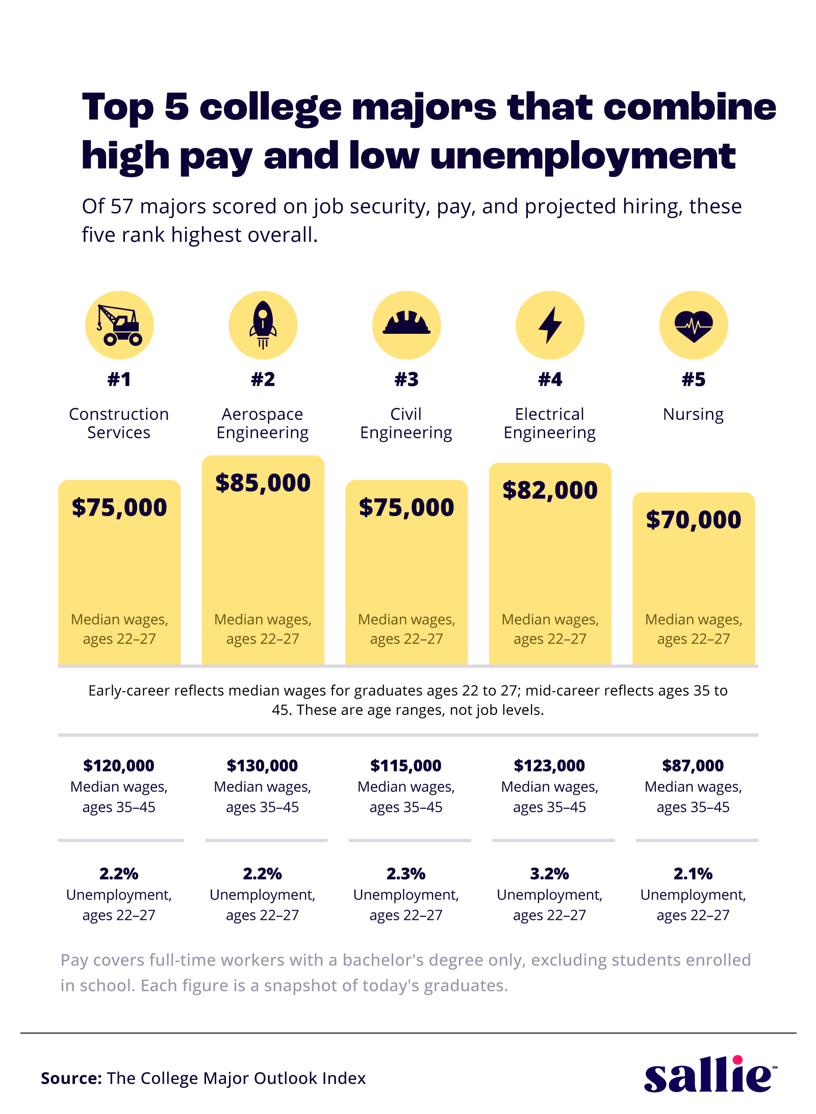
- Construction Services ranks first among 57 college majors in Sallie’s analysis of New York Fed and BLS data, which combines median wages, employment outcomes, and projected job openings.
- All five featured majors have median early-career wages (ages 22 to 27) of at least $70,000, led by Aerospace Engineering at $85,000.
- 4 of the 5 featured majors have median mid-career wages above $100,000. Nursing has lower mid-career wages pay ($87,000), but the lowest recent-graduate unemployment rate among these five fields (2.1%).
How 57 college majors compare on pay and job outlook
Based on New York Fed and BLS data, this ranking brings together median wages, employment outcomes, and projected job openings for 57 fields of study, so you can explore how each compares.
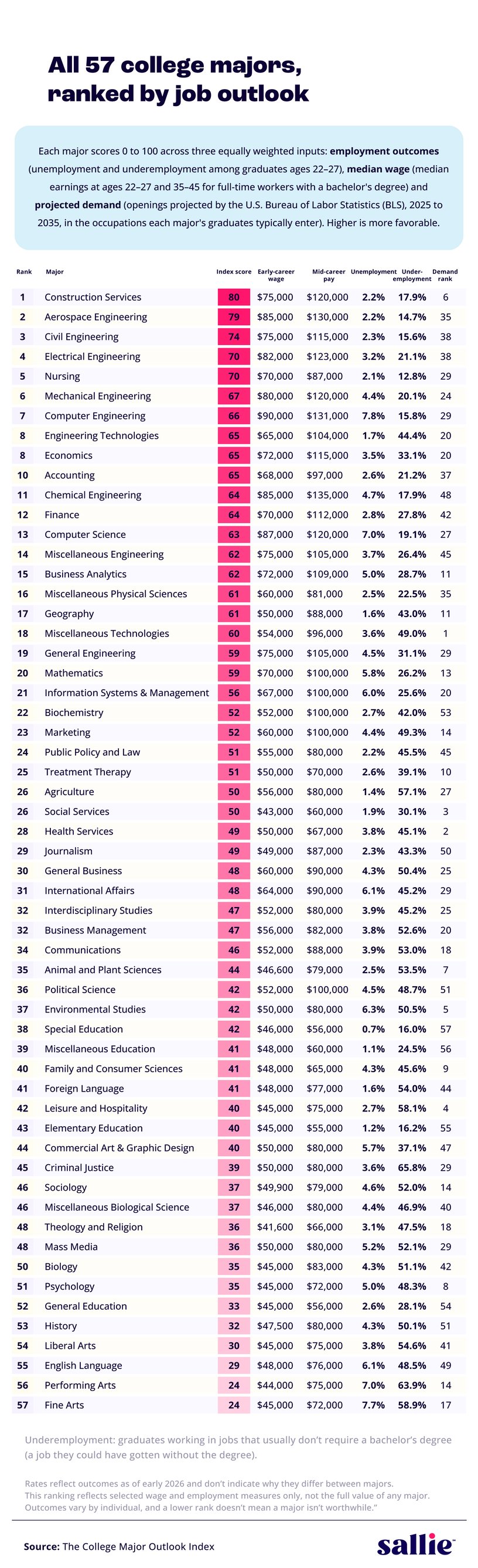
- Computer Engineering has both the highest early-career median wages ($90,000) and the highest recent-graduate unemployment rate (7.8%) among the 57 majors studied. It ranks 7th overall.
- Computer Science ranks second for early-career median wages ($87,000), but 13th overall. Its recent-graduate unemployment rate is 7.0%, the third highest in the study.
- Political Science has median mid-career earnings of $100,000, yet ranks 36th overall. Nearly half of its recent college graduates (48.7%) work in jobs that don't typically require a college degree.
The majors where pay grows the most between early to mid-career
The gap between early and mid-career median wages is much larger for some majors than others. These figures compare graduates ages 22 to 27 with those ages 35 to 45, rather than tracking individual raises.
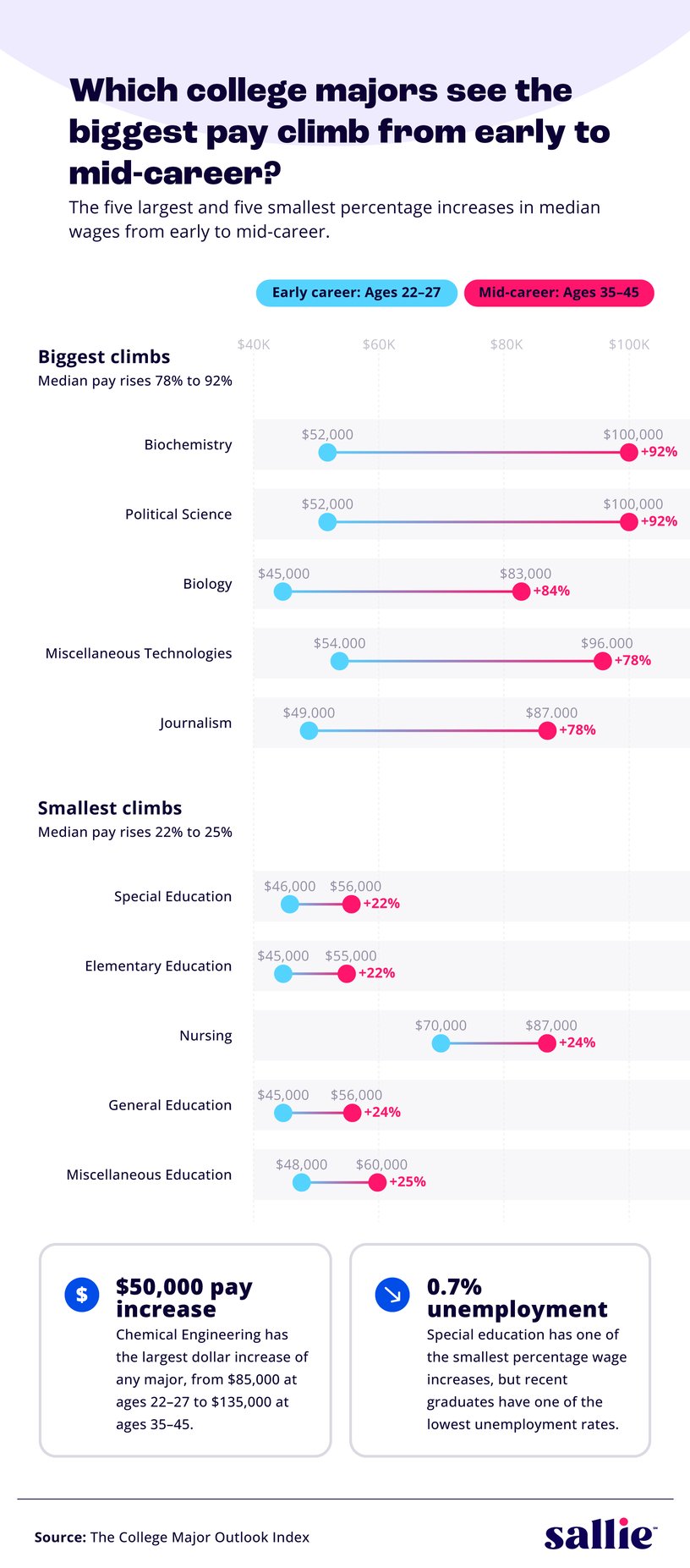
- The chart ranks majors by percentage growth. By dollar amount, the biggest increase goes to a different major.
- Biochemistry and Political Science have the largest percentage gap between early and mid-career median wages. Graduates ages 35 to 45 earn a median of $100,000, about 92% more than the $52,000 median for those ages 22 to 27.
- Chemical Engineering has the largest dollar increase ($50,000), with median wages rising from $85,000 to $135,000.
- Special Education and Elementary Education show the smallest growth, about $10,000 (22%), from roughly $45,000 to $55,000. Both are also among the lowest recent-graduate unemployment rates in the study (0.7% and 1.2%).
What this means if you're choosing a major
Finding your fit means weighing all the options, and sometimes the right major means earnings look different, which is okay. Wherever you land, Sallie can help you explore. Dig into fields of study with our college major guide, compare schools and programs with Scout College Search, and find free money first with Scholly Scholarships.
Methodology
Sallie reviewed federal data from the New York Fed and the U.S. Bureau of Labor Statistics, scoring 57 college majors (bachelor’s degree fields) on three equally weighted factors. Each major receives a score from 0 to 100 on each factor, and the three combine into an overall score from 0 to 100 that sets the ranking.
- Employment outcomes: unemployment and underemployment among recent college graduates only (ages 22 to 27 with a bachelor’s degree). Underemployment means working in a job that usually doesn’t require a bachelor’s degree, for example a role someone could have gotten without going to college. It reflects the job’s degree requirement, not the student’s field or pay.
- Median wages: early-career (ages 22 to 27) and mid-career (ages 35 to 45) for full-time workers with a bachelor’s degree. Unlike the employment figures, wages are shown for both age ranges.
- Projected job openings: openings projected by the U.S. Bureau of Labor Statistics (2025 to 2035) in the occupations each major’s graduates typically enter, including replacement hiring.
Sources:
- Graduate outcomes: Federal Reserve Bank of New York, The Labor Market for Recent College Graduates (February 2026 release, based on 2024 American Community Survey data).
- Demand projections: U.S. Bureau of Labor Statistics, Employment Projections (2025 to 2035).
The ranking highlights majors associated with higher median wages, lower unemployment, and stronger projected demand. It does not identify a single best major for every student, and a higher rank does not guarantee individual outcomes. Wage figures compare different age groups rather than tracking the same graduates over time. Projected openings reflect overall hiring activity, including replacement hiring, and do not guarantee opportunities for new graduates. The data reflects recent-graduate outcomes as of the New York Fed’s early 2026 release and does not identify why rates differ between majors, including any effect from technology or broader economic conditions.
This analysis focuses on earnings and unemployment outcomes. These metrics represent only part of the college value equation, which may also include affordability, career advancement opportunities, and personal goals, among other factors.
About Sallie
Sallie is an education-solutions company that helps guide students and families through the entire higher-education journey with trusted tools, free-money-first support, and clear guidance from day one to done. Sallie helps students find scholarships, navigate financial aid, plan for college with Scout, and feel more confident about the steps ahead.
Fair use statement
The findings in this report may be shared for noncommercial purposes. If you reference this research, please include a link back to this page so readers can review the full study and methodology.