-
Colleges
-
Graduate School
- Graduate School
- Scout Grad School Search Find and compare grad schools based on your preferences, goals and academic interests.
- $5,000 Grad School No Essay Scholarship† Enter to win our $5,000 no essay grad school scholarship in 2 min or less.
- Graduate Degrees Explore graduate degree options that fit your goals.
- Paying for Graduate School Understand costs and explore ways to pay for grad school.
-
Scholarships
- Scholarships
- $2,000 No Essay Scholarship† Enter to win our no essay $2,000 college scholarship in 2 minutes or less.
- Scholly Scholarships Easily find and sort through thousands of college scholarships for free.
- Scholarships for High School Seniors Explore scholarships for high school seniors and get tips on how to apply.
- Scholly Easy Apply Scholarships† Apply for up to $18,000 in scholarships each month with just one form.
- $5,000 Grad School No Essay Scholarship† Enter to win our $5,000 no essay grad school scholarship in 2 min or less.
-
Financial aid
- Financial Aid Grants, work-study, and federal student loans can all be part of your financial aid package.
- FAFSA® Guide Learn how to answer the 2027-28 FAFSA® questions like a pro.
- Financial Aid Offers Compare financial aid offers to determine the most affordable schools for you and your family.
- College Grants Learn more about federal and state grants and how to apply.
- Federal Pell Grants Discover what a Pell Grant is, who is eligible, and how to apply.
- Financial Aid Resources Get expert guidance on maximizing your financial aid options to make education more affordable.
-
Pay for School
- Sallie Mae® Student Loans
- Private Student Loans Find a private student loan designed to fit your needs.
- Undergrad Student Loan For college students earning a bachelor's or associate's degree.
- Graduate Student Loans Choose the right loan for your graduate degree or post-graduate studies.
- Career Training Loan For students taking professional training or certificate courses.
- Student Loan Resources Everything you need to navigate student loans with confidence.
.png?width=816&height=457&name=header-1920X1080%20(2).png)
The cost of college goes far beyond tuition. College families spent an average of $34,019 on college during the 2025-26 academic year, according to Sallie's "How America Pays for College 2026" study. That total reflects the full cost of attendance, including housing, books, transportation, and other everyday expenses.
To better understand one piece of that spending, we conducted a separate survey of 989 current U.S. college students about move-in costs, how they paid for them, and which purchases they considered worthwhile. The numbers show where families can plan ahead, and where a little budgeting goes a long way.
Key takeaways
- The average student spends $760 on move-in essentials like bedding, storage, and tech, expenses that are separate from tuition, rent, or housing fees.
- More than 2 in 5 students (43%) never set a move-in budget, and 55% of them later wished they had.
- More than half of students (53%) used a credit card for at least some move-in purchases, carrying an average balance of $319 into the semester.
- 59% of students felt pressure to build a social-media-worthy dorm.
- Nearly 1 in 4 students (24%) bought a specific dorm or room item after seeing it go viral on social media.
The real move-in bill
Before rent or tuition entered the picture, students were already spending hundreds to get settled in.
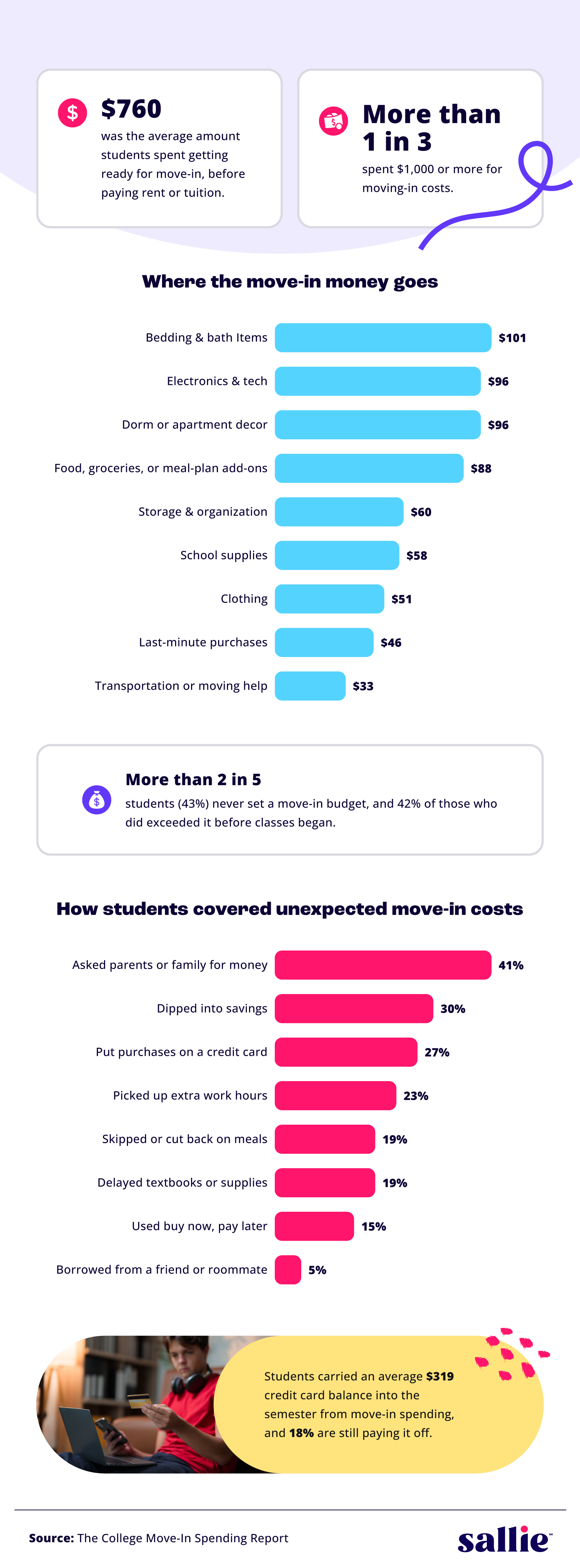
What students spend getting ready for move-in
- Students spent an average of $760 preparing for move-in before rent or tuition, and nearly 3 in 10 (28%) spent over $1,000.
- Bedding and bath ($101), electronics ($96), decor ($96), and food ($88) were among the biggest typical move-in expenses.
- Electronics ranks high despite about a third of students spending nothing on tech. Among those who did buy, purchases like laptops pushed spending, on average, well past $200, with the top spenders exceeding $600.
- Dorm and apartment essentials were the cost that caught students off guard the most often (20%).
Move-in spending outpaces students' plans and lingers into the semester
- 43% of students didn't set a move-in budget, and 55% of them later said they wished they had. Even among those who did set one, 42% still went over it.
- Students whose parents paid for move-in items were more likely to skip setting a budget than those paying their own way (52% vs. 34%).
- More than half of students (53%) used a credit card for at least some move-in purchases, carrying an average balance of $319 into the semester, and nearly 1 in 5 (18%) were still working that balance down weeks into the fall term.
- Move-in costs pushed some students to cut into semester basics, trimming food and meal spending (19%) and textbook or school-supply purchases (19%).
- Students receiving financial aid felt the squeeze more. They were more likely to skip or cut meals (21% vs. 15%), pick up extra work hours (24% vs. 19%), and use buy now, pay later (17% vs. 9%) than students without aid. They were also about 1.7 times as likely to still be paying off move-in purchases at the start of the semester (20% vs. 12%).
The aesthetic premium
For many students, the pressure wasn't just to be ready for move-in. They also felt the need to make the space look good enough to post about on social media.
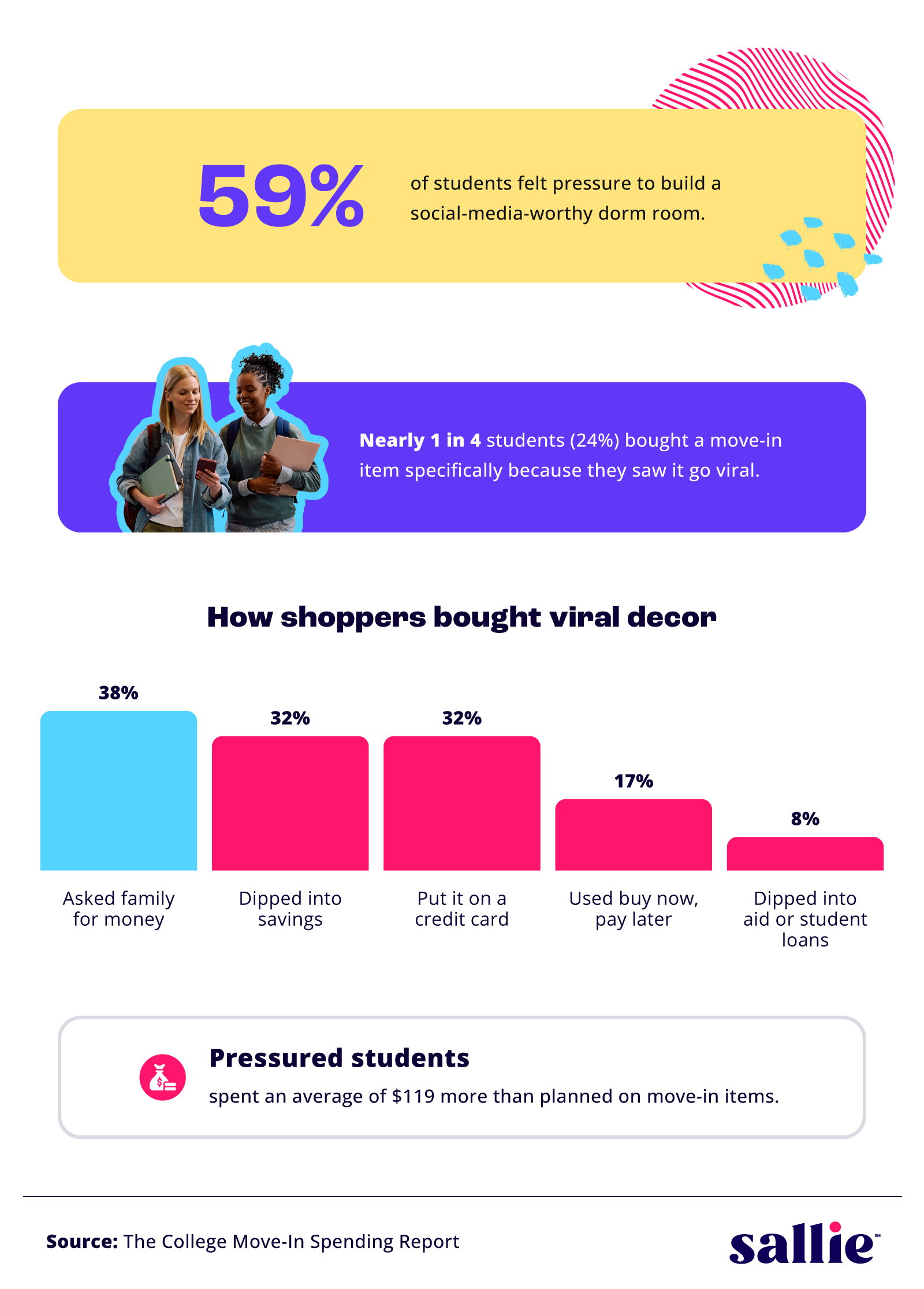
Social media showed up in students' spending in a few ways:
- 59% of students felt pressure to build a social-media-worthy dorm.
- Among students who felt that pressure, 58% spent an average of $119 more than they'd planned trying to create an aesthetic dorm.
- Nearly 1 in 4 students (24%) bought a move-in item specifically because it went viral on social media.
- Among students swayed by what they saw online, 75% took on extra costs for move-in items. To cover the expense, 38% asked family, 32% dipped into savings, 32% used a credit card, and 17% used buy now, pay later.
Sticker shock and second thoughts
Higher-than-expected prices turned move-in into a bigger bill than most students bargained for, and once the boxes were unpacked, many had second thoughts about where the money went.
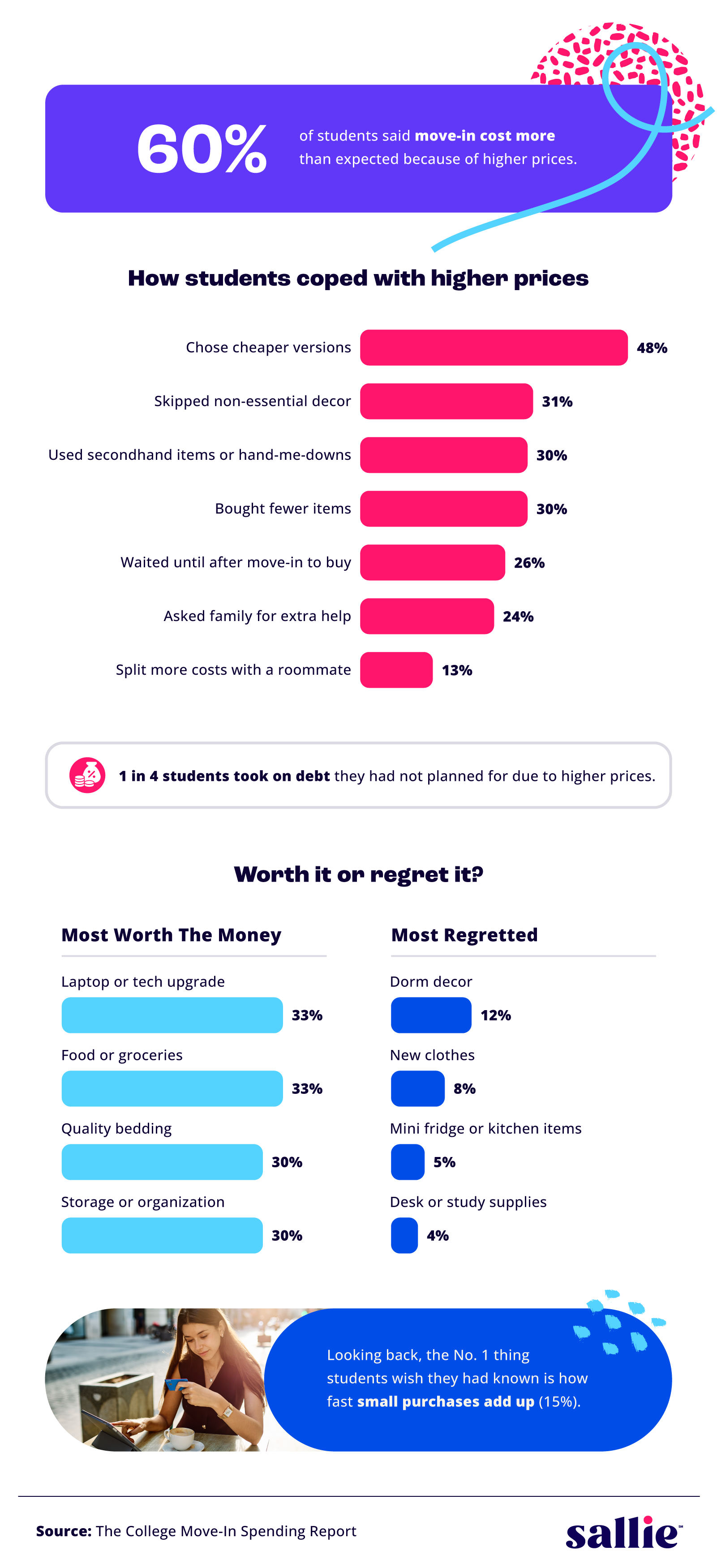
Here's what students said about the value of their spending:
- Laptop or tech upgrades and quality bedding (both 33%) were the purchases students were most likely to call worth it. Decor was the buy they most regretted (12%).
- 60% said move-in felt more expensive than they’d expected, with many pointing to what they believed were rising prices on everyday items.
- Almost half of students (49%) chose cheaper versions of what they needed to save money.
- The thing students most often wished they'd known going in was how fast small purchases add up (15%).
- Students weren't imagining the higher prices. According to the Bureau of Labor Statistics, prices rose year over year across several common move-in categories, including apparel (+4.8%), housekeeping supplies (+2.9%), groceries (+2.7%), household furnishings and supplies (+2.4%), and computers, peripherals, and smart home assistants (+1.3%).
- Faced with higher-than-expected costs, 26% of students took on debt they hadn't planned for: 14% put more on a credit card than intended, 10% used buy now, pay later when they hadn't planned to, and 9% borrowed money they hadn't expected to.
- Things were even trickier for students getting financial aid. 1 in 4 aid recipients (25%) didn't know what their aid covered: 14% assumed it would cover move-in costs like bedding and decor (and later learned it wouldn't), and another 11% weren't sure what their aid covered at all.
Find help for move-in day and beyond
Move-in is one of the first major college expenses students face, and for many, it's easy to underestimate how quickly the costs add up. A few simple habits can ease the pressure:
- Prioritizing what you actually need before buying extras helps reduce impulse purchases.
- Talking with your roommate ahead of time keeps you from ending up with two of everything.
- Waiting until you're settled to see what's still missing can prevent overbuying.
- Gently used items can cover plenty of dorm basics for less.
It also helps to understand what financial aid covers, and exploring scholarships can free up money for tuition and other college expenses. Scholly Scholarships from Sallie can help students find free money to put toward those costs.
Methodology
A survey conducted by Fractl on behalf of Sallie in 2026 surveyed 989 current U.S. college students about the cost of preparing for move-in. The survey was fielded online via Prolific, and only responses with a valid, unique respondent ID were included in the analysis. Respondents span gender, school type (4-year public, 4-year private, and 2-year or community college), year in school (incoming freshman and returning undergraduates), living situation, who pays for move-in, and financial aid and work status. Age was grouped into generations: Gen Z (29 and under), millennials (30 to 45), Gen X (46 to 61), and baby boomers (62 and older). The sample skews Gen Z (78%) and millennials (18%), consistent with the current college population. All participants were adults 18 or older.
For spending questions, figures are reported as averages with outliers removed using the IQR method to prevent extreme values from distorting typical spend. Select-all-that-apply questions allowed multiple responses, so those percentages can total more than 100%. Several questions used skip logic and were asked only of relevant respondents: budget regret (students who set no budget, n=421), credit card balances (card users, n=520), aesthetic overspending (students who felt pressure, n=588), and influenced-purchase financing (students swayed by a viral post, n=241). Percentages are rounded to the nearest whole number and dollar figures to the nearest dollar, so some totals may not add up to exactly 100%. Demographic takeaways are reported only for segments representing at least 5% of respondents.
You can find more of Sallie's research on paying for college on our leading research page.
About Sallie
Sallie is an education-solutions company that helps guide students and families through the entire higher-education journey with trusted tools, free-money-first support, and clear guidance from day one to done. Sallie helps students find scholarships, navigate financial aid, plan for college with Scout, and feel more confident about the steps ahead.
Fair use statement
The findings in this report may be shared for noncommercial purposes. If you reference this research, please include a link back to this page so readers can review the full study and methodology.
Brand names referenced in this report are trademarks of their respective owners and are used for descriptive purposes only. This study is independent and not affiliated with or endorsed by those companies.