-
Colleges
-
Graduate School
- Graduate School
- Scout Grad School Search Find and compare grad schools based on your preferences, goals and academic interests.
- $5,000 Grad School No Essay Scholarship Enter to win our $5,000 no essay grad school scholarship in 2 min or less.
- Graduate Degrees Explore graduate degree options that fit your goals.
- Paying for Graduate School Understand costs and explore ways to pay for grad school.
-
Scholarships
- Scholarships
- $2,000 No Essay Scholarship Enter to win our no essay $2,000 college scholarship in 2 minutes or less.
- Scholly Scholarships Easily find and sort through thousands of college scholarships for free.
- Scholarships for High School Seniors Explore scholarships for high school seniors and get tips on how to apply.
- Scholly Easy Apply Scholarships Apply for up to $13,000 in scholarships each month with just one form.
- $5,000 Grad School No Essay Scholarship Enter to win our $5,000 no essay grad school scholarship in 2 min or less.
-
Financial aid
- Financial Aid Grants, work-study, and federal student loans can all be part of your financial aid package.
- FAFSA® Guide Learn how to answer the 2027-28 FAFSA® questions like a pro.
- Financial Aid Offers Compare financial aid offers to determine the most affordable schools for you and your family.
- College Grants Learn more about federal and state grants and how to apply.
- Federal Pell Grants Discover what a Pell Grant is, who is eligible, and how to apply.
- Financial Aid Resources Get expert guidance on maximizing your financial aid options to make education more affordable.
-
Pay for School
- Sallie Mae® Student Loans
- Private Student Loans Find a private student loan designed to fit your needs.
- Undergrad Student Loan For college students earning a bachelor's or associate's degree.
- Graduate Student Loans Choose the right loan for your graduate degree or post-graduate studies.
- Career Training Loan For students taking professional training or certificate courses.
- Student Loan Resources Everything you need to navigate student loans with confidence.

Paying for college is full of decisions, and many of them hinge on what families believe they qualify for. Misunderstandings about financial aid eligibility, especially around the FAFSA® and the federal aid it unlocks, can shape choices about which schools to consider, how much to borrow, and whether college even feels possible.
Sallie surveyed 1,000 U.S. students and parents involved in paying for college to find out which myths about financial aid are most widely believed and what those misconceptions are costing students and families. If any of them sound familiar, knowing the facts could change what you apply for and what you're able to afford.
Key takeaways
- 43% of families paying for college believe or suspect they missed out on federal financial aid they may have been eligible for.
- 29% of families paying for college skipped applying for federal aid, specifically Pell grants and federal student loans, which require completing the FAFSA®, because they assumed they wouldn't qualify.
- 76% of families that skipped applying for federal aid, specifically Pell grants or federal student loans, believe at least one major financial aid myth, compared to 63% of families who did apply.
- Over 2 in 5 families paying for college (41%) believe a household income above $100,000 disqualifies students from any financial aid, a common misconception.
- Nearly 1 in 4 families paying for college (24%) said they later learned they may have qualified for financial aid they didn't apply for, and 33% of them estimated they missed out on $10,000 or more in aid.
- 73% of families currently paying for college or who recently paid for it wish they had access to a clearer, step-by-step guide when navigating financial aid.
Misconceptions that keep families from applying for financial aid
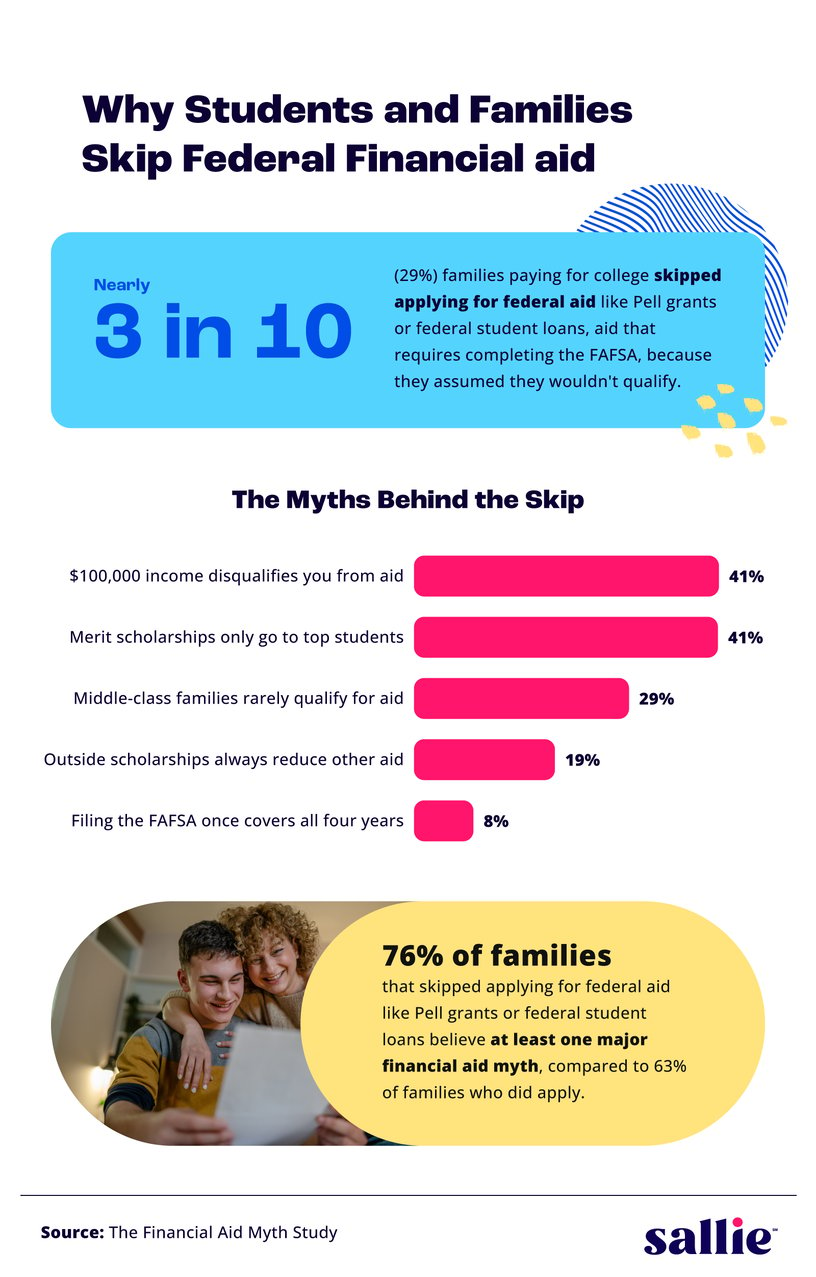
- The top 5 most common myths about financial aid are:
- $100,000 income disqualifies you from aid: 41%
- Merit scholarships only go to top students: 41%
- Middle-class families rarely qualify for aid: 29%
- Outside scholarships always reduce other aid: 19%
- Filing the FAFSA® once covers all 4 years of college: 8%
- Families who skipped applying for federal aid, specifically Pell grants or federal student loans, believed each myth at higher rates than families who did apply:
- $100,000 income disqualifies you from aid: 49% of skippers vs. 37% of non-skippers
- Merit scholarships only go to top students: 48% of skippers vs. 39% of non-skippers
- Outside scholarships always reduce other aid: 28% of skippers vs. 16% of non-skippers
- More than half of families paying for college (54%) skipped applying for at least one type of financial aid because they assumed they wouldn't qualify. The most commonly skipped types were private or outside scholarships (26%), followed by three aid types that require completing the FAFSA®: work-study (23%), state grants (22%), and federal Pell grants (21%).
- Students were more likely than parents to skip applying for at least one type of financial aid (60% vs. 48%) and to believe the $100,000 myth (45% vs. 36%). In reality, there is no income cap on financial aid eligibility, and many factors beyond household income affect what families qualify for.
- The middle-class myth was most common among households earning $100,000 to $149,999 annually. Among that group, 40% believed middle-class families rarely qualify for meaningful aid, compared to 27% of those earning under $100,000.
- Most families did seek out financial aid information from credible sources. They most often turned to college financial aid offices (46%) and government websites (32%), and only 5% said they didn't seek out any information at all.
The real cost of walking away from aid
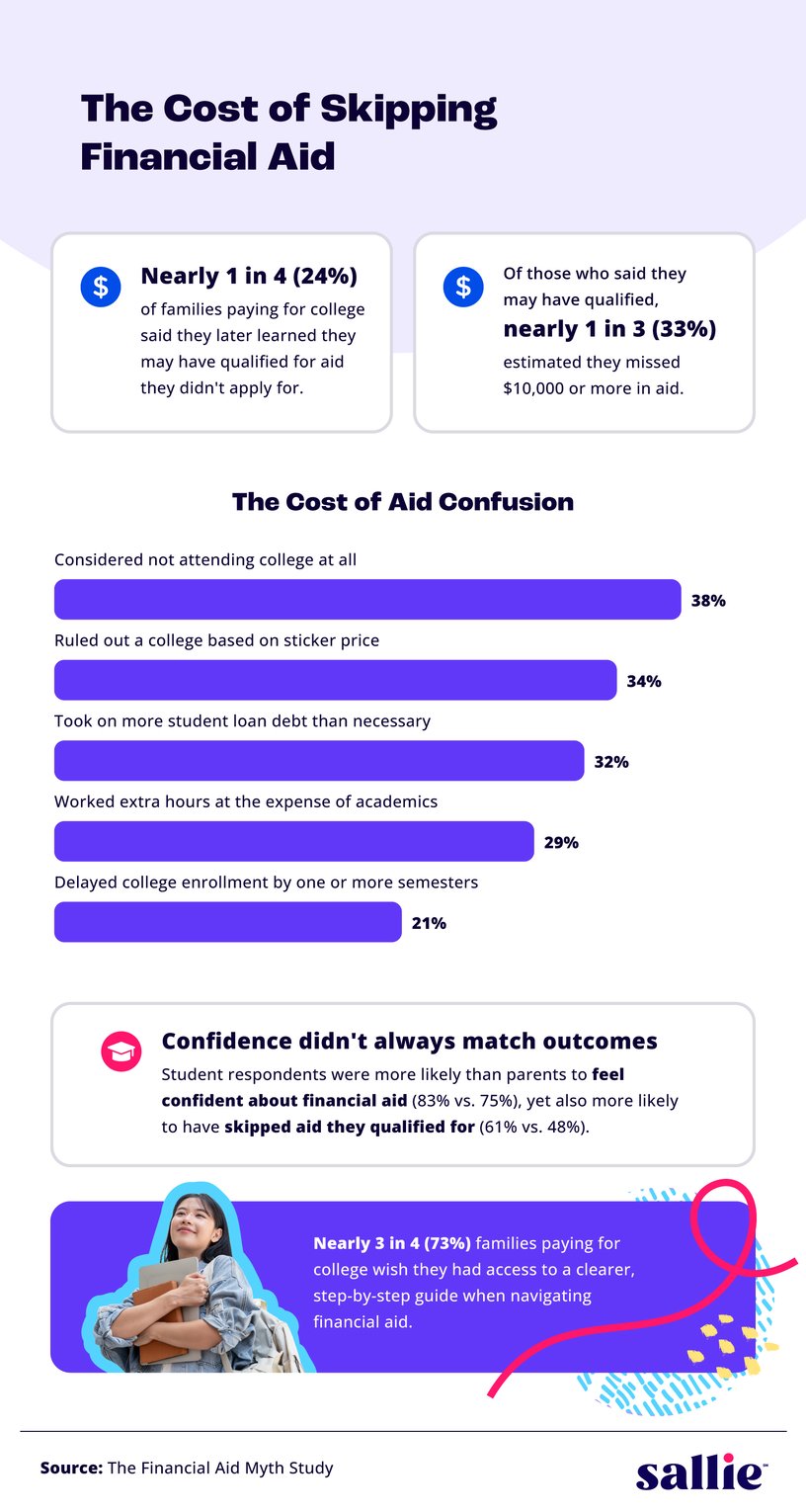
- The fallout from aid confusion shows up in major college decisions:
- 38% of students considered not attending college.
- 34% ruled out a college based on sticker price.
- 32% took on more student loan debt, federal or private, than necessary.
- 29% took on extra work hours that left less time for schoolwork.
- 21% delayed enrollment by one or more semesters.
- Nearly 4 in 5 families (79%) felt confident in their financial aid understanding before applying.
- Among "very confident" respondents, 27% later learned they had missed out, compared to 19% of those who described themselves as "not very confident."
- Student respondents reported more confidence in their financial aid knowledge than parent respondents (83% vs. 75%), yet were also more likely to say they had skipped aid they qualified for (61% vs. 48%).
- Among student respondents, 1 in 2 Millennial students (50%) said they took on more student loan debt than necessary because of aid uncertainty, twice the rate of Gen Z students (26%). Among parent respondents, Millennials and Gen X reported similar rates (31% and 29%).
- Over 2 in 5 families paying for college (43%) said they later learned they may have qualified for aid they didn't apply for, including 24% who confirmed they did and 19% who weren't sure.
- Looking back more broadly, 63% of families agreed they may have missed out on aid they were eligible for, and 60% said they would have made different decisions about paying for college if they had had better information.
How to maximize your aid with more confidence
To make more informed decisions about financial aid, focus on a few simple steps:
- Apply every year, even if you assume you won't qualify. Eligibility depends on many factors beyond household income, including family size, school costs, and how many kids are in college at once. There's no income cap to file the FAFSA®, and the form needs to be filed every year a student is enrolled, not just once. Filing as early as possible also matters: some grants, scholarships, and other aid are awarded on a first-come, first-served basis. Sallie's step-by-step FAFSA® guide walks families through each section of the application, explains why each question matters and how to answer it correctly, and helps maximize financial aid eligibility.
- Don't stop at federal aid. The FAFSA® is the gateway to federal aid like Pell grants, federal student loans, and work-study, but it's just one piece of the funding picture. Outside scholarships, state grants, and institutional aid from your school can all help too. Sallie's scholarship guide walks through the different types of scholarships and how to find them.
- Apply early and often. Smaller scholarships still add up, and the students who win the most aid usually apply to many. The $2,000 No Essay Scholarship takes only a few minutes to enter, and Scholly Scholarships can help match students with awards that fit their background, interests, and goals.
- Keep applying once you're enrolled. Most scholarships stay open to current students, not just incoming freshmen. The FAFSA® also has to be filed every year your student is enrolled.
For families still researching schools, Scout College Search can help match students with programs that fit both their goals and their financial picture.
Methodology
Sallie surveyed 1,000 U.S. students and parents currently paying for college or who recently paid for it in 2026 about their beliefs around financial aid eligibility and the financial consequences of those beliefs. Respondents were asked about myth beliefs, aid types they applied for or skipped, decisions made under uncertainty, money left on the table, and information sources used.
The sample was 50% students or parents of current college students and 50% recent graduates or parents of recent graduates, within the past five years. The gender breakdown was 66% women, 32% men, and 2% non-binary or prefer not to say. Generations represented include Gen Z (35%), Millennials (32%), Gen X (30%), and Baby Boomers (3%). Student respondents had a mean age of 22, and parent respondents had a mean age of 50.
About Sallie
Sallie is an education-solutions company that helps guide students and families through the entire higher-education journey with trusted tools, free-money-first support, and clear guidance from day one to done. Sallie helps students find scholarships, navigate financial aid, plan for college with Scout, and feel more confident about the steps ahead.
Fair use statement
The information in this article may be used for noncommercial purposes only. If you share it, please include a link and an attribution to Sallie.