-
Colleges
-
Graduate School
- Graduate School
- Scout Grad School Search Find and compare grad schools based on your preferences, goals and academic interests.
- $5,000 Grad School No Essay Scholarship† Enter to win our $5,000 no essay grad school scholarship in 2 min or less.
- Graduate Degrees Explore graduate degree options that fit your goals.
- Paying for Graduate School Understand costs and explore ways to pay for grad school.
-
Scholarships
- Scholarships
- $2,000 No Essay Scholarship† Enter to win our no essay $2,000 college scholarship in 2 minutes or less.
- Scholly Scholarships Easily find and sort through thousands of college scholarships for free.
- Scholarships for High School Seniors Explore scholarships for high school seniors and get tips on how to apply.
- Scholly Easy Apply Scholarships† Apply for up to $18,000 in scholarships each month with just one form.
- $5,000 Grad School No Essay Scholarship† Enter to win our $5,000 no essay grad school scholarship in 2 min or less.
-
Financial aid
- Financial Aid Grants, work-study, and federal student loans can all be part of your financial aid package.
- FAFSA® Guide Learn how to answer the 2027-28 FAFSA® questions like a pro.
- Financial Aid Offers Compare financial aid offers to determine the most affordable schools for you and your family.
- College Grants Learn more about federal and state grants and how to apply.
- Federal Pell Grants Discover what a Pell Grant is, who is eligible, and how to apply.
- Financial Aid Resources Get expert guidance on maximizing your financial aid options to make education more affordable.
-
Pay for School
- Sallie Mae® Student Loans
- Private Student Loans Find a private student loan designed to fit your needs.
- Undergrad Student Loan For college students earning a bachelor's or associate's degree.
- Graduate Student Loans Choose the right loan for your graduate degree or post-graduate studies.
- Career Training Loan For students taking professional training or certificate courses.
- Student Loan Resources Everything you need to navigate student loans with confidence.

Gen Z is heading back to school with a plan. Sallie surveyed 500 U.S. Gen Z college students and recent college graduates, all of whom are currently enrolled in graduate school, planning to enroll within the next 12 months, or actively considering it, to understand how they're approaching this decision right now. What emerged is a picture of a generation that's clear-eyed about the value of advanced education.
They're weighing earning potential, exploring funding options, and making deliberate decisions about when and how to invest in their futures. The motivations, financial strategies, and timing decisions behind the grad school choice reveal just how carefully Gen Z is doing the math.
Key takeaways
- About 4 in 5 Gen Z college students and recent college graduates (81%) would rather spend the next two years in graduate school than enter the job market right now.
- Higher earning potential (65%) and career advancement (64%) are the top reasons Gen Z is pursuing grad school.
- About 3 in 5 Gen Z (61%) agree that a master's degree is the new bachelor's degree.
- 3 in 5 Gen Z (60%) are confident they'll earn back their grad school investment within five years of graduating.
- Gen Z is willing to make tradeoffs to pursue grad school, including delaying milestones like having children (19%), starting a full-time career (14%), and buying a home (13%).
Why Gen Z is pursuing grad school
For most Gen Z college students and recent college graduates, the decision to pursue grad school comes down to more than one thing.
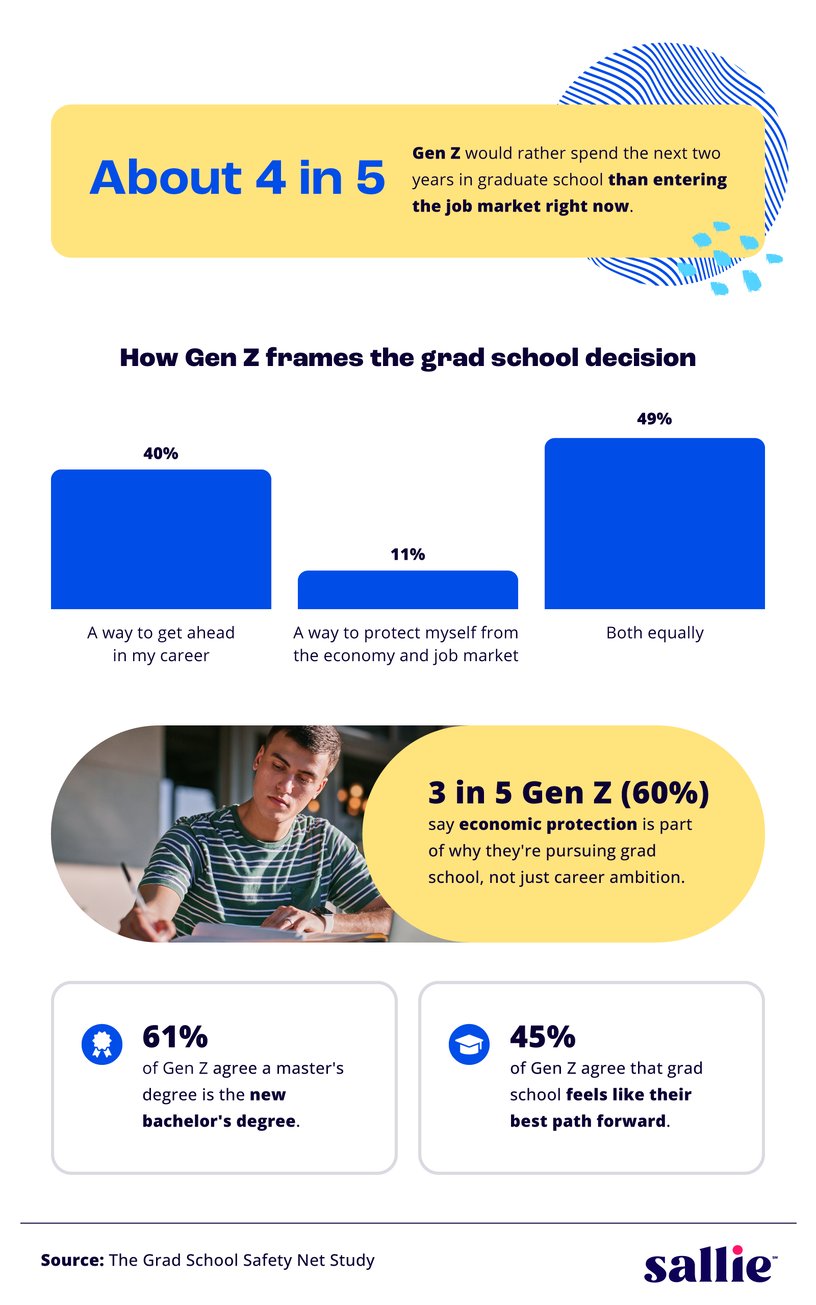
Gen Z's top "why" behind pursuing a graduate education is higher earning potential (65%), followed closely by career advancement (64%). More than half cite their love of the subject or passion for the field (56%), a reason especially common among Gen Z women, about 3 in 5 (61%) of whom named it as a primary driver. Fewer point to fear of being uncompetitive in the job market (25%) and needing time to figure things out (12%).
For some Gen Z, grad school has been part of the plan for a long time. Nearly 3 in 10 Gen Z currently enrolled in a graduate program first seriously considered it before they even started college. That interest extends across the broader group, too. About 4 in 5 Gen Z college students and recent college graduates (81%) said they'd rather spend the next two years in graduate school than entering the job market right now, a sign of how intentionally this group is thinking about where to invest their time.
When asked whether they see grad school as a way to get ahead or as protection from the economy, about half (49%) said both equally. Another 40% framed it as a career advancement move, while 11% described it strictly as economic protection.
The sense that credentials matter more than ever is also part of the picture, with 61% of Gen Z agreeing that a master's degree is the new bachelor's degree. About 3 in 5 Gen Z currently enrolled in a graduate program said they would struggle to land a quality job without a graduate degree. Once Gen Z decides grad school is the right move, the next step is figuring out how to fund it.
How Gen Z is making grad school happen
For many Gen Z, planning for grad school means careful thinking about finances and life timing. The math has to add up before they apply.
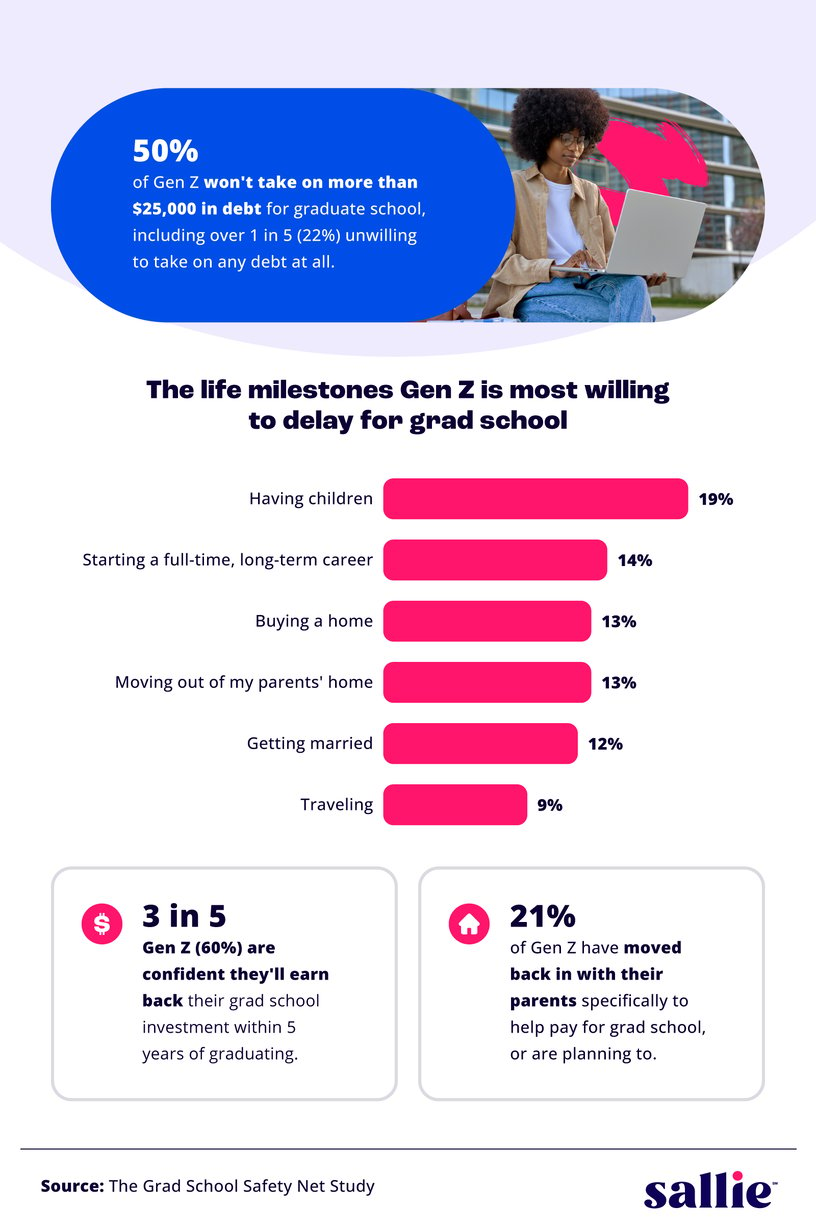
Gen Z sees the payoff. 3 in 5 (60%) are confident they'll earn back their grad school investment within just five years of graduating, a view consistent with their broader belief that advanced degrees have become essential in today's job market, but that confidence hasn't made them careless about debt. Half of Gen Z (50%) said they wouldn't take on more than $25,000 in debt for graduate school, including 22% who weren't willing to take on any debt at all. It's a picture of Gen Z willing to invest, but thoughtfully.
When it came to paying for grad school, scholarships or grants topped the list. About 2 in 5 Gen Z (41%) plan to rely most on scholarships or grants, ahead of federal student loans (37%) and working while in school (35%). Personal savings (17%), private student loans (12%), and help from parents (11%) rounded out the top funding sources. These plans were measured as federal borrowing rules were shifting. As of July 2026, new limits on federal graduate loans mean some students may need to plan around a wider mix of funding sources than in years past. Employer support is also helping some Gen Z. Nearly 1 in 5 employed full-time said they plan to rely most on employer tuition assistance to pay for grad school.
That approach shifts as the decision gets closer. Among Gen Z planning to enroll within the next 12 months, 3 in 5 (60%) said they'd be willing to take on at least $25,000 in debt for grad school. And when forced to choose between taking on $100,000 in debt or continuing to job hunt, more than 2 in 5 (42%) chose the debt. Parents remain a critical part of the plan, with nearly half naming a parent as their planned or current loan cosigner.
Many Gen Z are also factoring in timing decisions around other life milestones. About 1 in 5 Gen Z (21%) have moved back in with their parents or plan to in order to help pay for grad school. This number climbed to nearly 1 in 3 among those enrolling within the next 12 months. Only 8% of Gen Z said they wouldn't delay any life milestone for grad school. The other 92% were willing to push something back. Having children topped the list of what they'd delay first (19%), followed by starting a full-time career (14%), buying a home (13%), and moving out of their parents' home (13%).
What Gen Z is studying
The path to a master's degree looks different for every student. The graphic below breaks down Gen Z's motivations, funding plans, and program choices. Here's a closer look at what they're studying and when they decided.
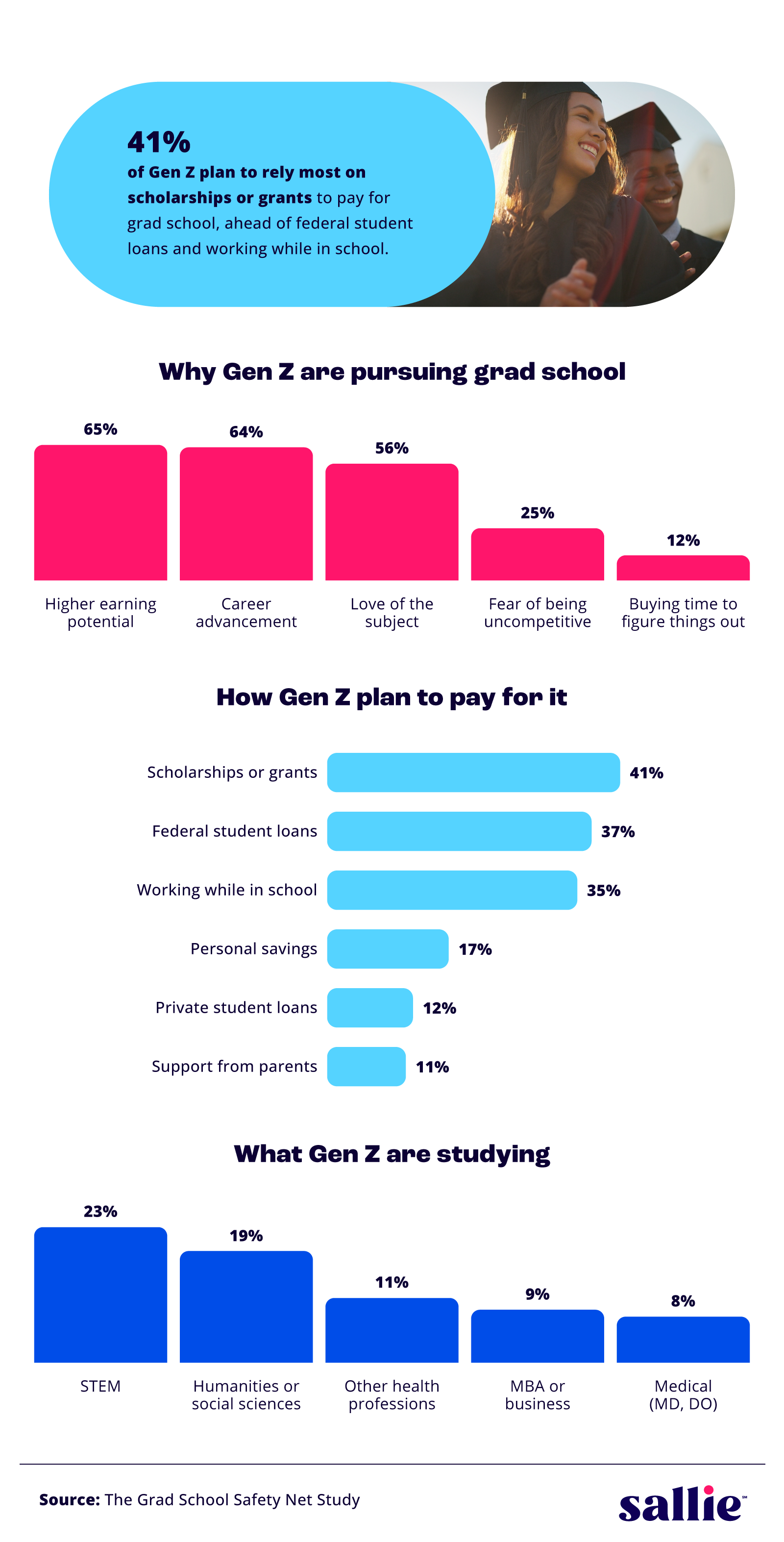
Gen Z's grad school plans span a mix of fields, with STEM leading the pack.
- STEM (23%)
- Humanities or social sciences (19%)
- Other health professions (11%)
- MBA or business (9%)
- Medical programs like MD or DO (8%)
For most Gen Z, grad school wasn't a last-minute decision. Half (51%) first seriously considered it while they were in college, and another 25% had it in mind before they even started their undergraduate degree. Among Gen Z currently enrolled in a graduate program, nearly 3 in 10 (29%) had been thinking about it since before college. Only about 1 in 5 came to the decision after entering the workforce, suggesting that for many, advanced education is a long-considered plan.
Doing the math
Gen Z isn't drifting into grad school. They're making a calculated bet. They're weighing what they'll gain against what they'll owe, planning around debt caps, and looking for free money before loans. Most are confident they'll earn back the investment within five years, and they're weighing how grad school fits with other life goals like starting a career, buying a home, or starting a family.
Sallie helps students navigate every stage of the graduate school journey, from finding scholarships and understanding financing options to choosing a school that fits their goals so they can move forward with confidence.
Methodology
Sallie surveyed 500 U.S. Gen Z college students and recent college graduates 18 to 29 in 2026 about their motivations, financial tradeoffs, and decisions around graduate school. Respondents were asked about reasons for pursuing grad school, decision framing between career ambition and economic protection, sources of encouragement, beliefs about credentialing in today's job market, debt willingness and funding strategies, and life milestones they would delay. The gender breakdown was 65% women, 32% men, and 3% non-binary. All respondents were Gen Z, with a mean age of 24 years. Figures may not sum to 100% due to rounding.
About Sallie
Sallie is an education-solutions company that helps guide students and families through the entire higher-education journey with trusted tools, free-money-first support, and clear guidance from day one to done. Sallie helps students find scholarships, navigate financial aid, plan for college with Scout, and feel more confident about the steps ahead.
Fair use statement
The information in this article may be used for noncommercial purposes only. If you share it, please include a link and an attribution to Sallie.