-
Colleges
-
Graduate School
- Graduate School
- Scout Grad School Search Find and compare grad schools based on your preferences, goals and academic interests.
- $5,000 Grad School No Essay Scholarship† Enter to win our $5,000 no essay grad school scholarship in 2 min or less.
- Graduate Degrees Explore graduate degree options that fit your goals.
- Paying for Graduate School Understand costs and explore ways to pay for grad school.
-
Scholarships
- Scholarships
- $2,000 No Essay Scholarship† Enter to win our no essay $2,000 college scholarship in 2 minutes or less.
- Scholly Scholarships Easily find and sort through thousands of college scholarships for free.
- Scholarships for High School Seniors Explore scholarships for high school seniors and get tips on how to apply.
- Scholly Easy Apply Scholarships† Apply for up to $18,000 in scholarships each month with just one form.
- $5,000 Grad School No Essay Scholarship† Enter to win our $5,000 no essay grad school scholarship in 2 min or less.
-
Financial aid
- Financial Aid Grants, work-study, and federal student loans can all be part of your financial aid package.
- FAFSA® Guide Learn how to answer the 2027-28 FAFSA® questions like a pro.
- Financial Aid Offers Compare financial aid offers to determine the most affordable schools for you and your family.
- College Grants Learn more about federal and state grants and how to apply.
- Federal Pell Grants Discover what a Pell Grant is, who is eligible, and how to apply.
- Financial Aid Resources Get expert guidance on maximizing your financial aid options to make education more affordable.
-
Pay for School
- Sallie Mae® Student Loans
- Private Student Loans Find a private student loan designed to fit your needs.
- Undergrad Student Loan For college students earning a bachelor's or associate's degree.
- Graduate Student Loans Choose the right loan for your graduate degree or post-graduate studies.
- Career Training Loan For students taking professional training or certificate courses.
- Student Loan Resources Everything you need to navigate student loans with confidence.

Graduate school marks a major step, and for many students, it brings a wave of decisions around cost, timing, and career direction. Students often focus on long-term career goals, but the expenses, time demands, and impact on work-life balance tend to surface once classes begin.
To better understand that transition, Sallie surveyed 543 U.S. graduate students, both currently enrolled and recently graduated, about how prepared they felt at the start and how confident they feel today. The results show that students who enter grad school with a clear financial plan and a strong sense of direction feel more in control from day one.
Key takeaways
- Nearly 1 in 2 graduate students (48%) would give different advice to someone starting grad school than what they received. Balancing work and life (48%) was the area where students most wished they had better guidance before enrolling.
- Earning potential (60%) and personal fulfillment (59%) were the top reasons why graduate students pursued their degree, followed by job security (40%).
- 89% of graduate students who planned financially before enrolling are satisfied with their decision, compared to just 70% of those who did not.
- 87% of graduate students who entered their program with clear career goals are satisfied with their decision to pursue a graduate degree, compared to just 60% of those who enrolled without them.
- 2 in 3 graduate students (67%) experienced at least one unexpected challenge since enrolling, with financial cost (31%) being the most common.
- Only 30% of graduate students felt very prepared going into their program, yet nearly 9 in 10 (89%) are either confident or neutral about it being the right career decision.
Grad school is worth it, but preparation makes all the difference
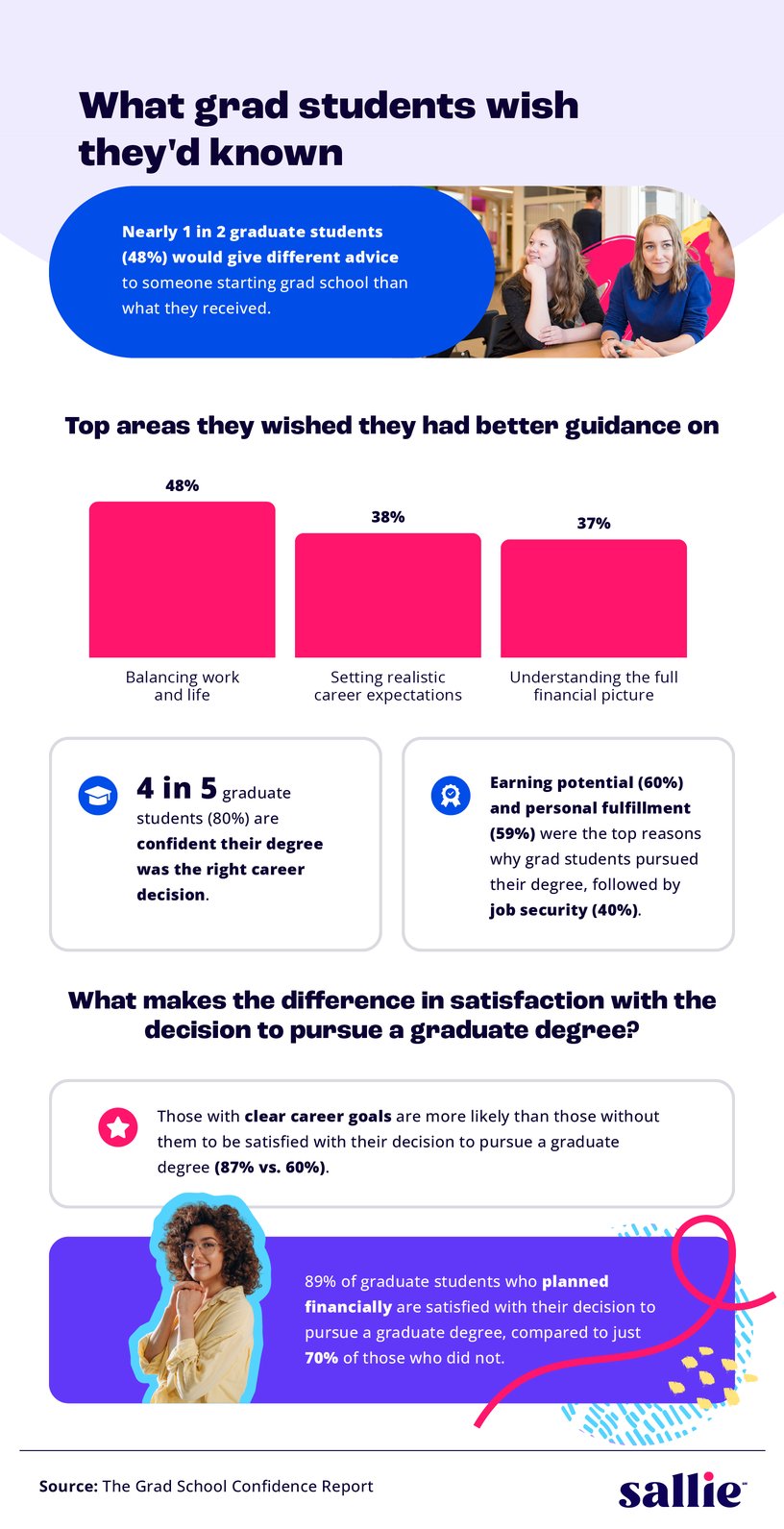
- Balancing work and life (48%) is the most common area where students wish they had better guidance. Setting realistic career expectations (38%) and understanding the full financial picture (37%) are also major guidance gaps.
- Grad students with clear career goals were more likely to see their confidence in their graduate education decision increase after enrolling (57%) than those without clear goals (39%).
- 57% of grad students say financial planning helped them feel more in control during their program.
- Overall, 81% of graduate students are satisfied with their decision to pursue a graduate degree, including 39% who are very satisfied and 42% who are somewhat satisfied.
- 80% of grad students are confident their degree will provide long-term career and financial value. Hybrid students (86%) and in-person students (82%) are more confident in the long-term value of their degree than online students (74%).
Where grad programs delivered and where students expected more
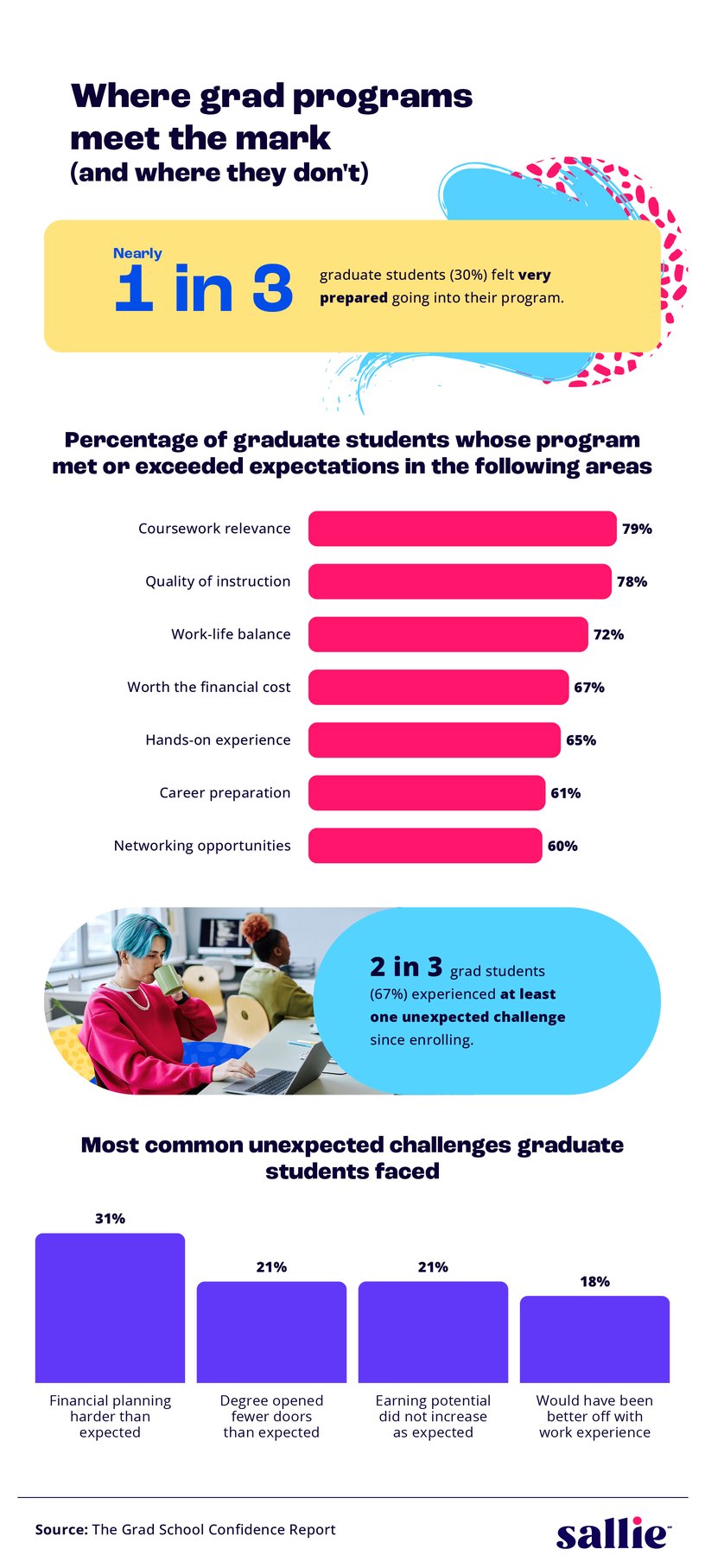
- According to students, coursework relevance (79%) and quality of instruction (78%) are the areas where graduate programs have most often met or exceeded expectations.
- Career preparation (61%) and networking opportunities (60%) still met or exceeded expectations for a majority of students, though they trailed areas like coursework relevance (79%) and instruction quality (78%) by a notable margin.
- Millennials (37%) are more likely to say they felt very prepared before enrolling than Gen X students (33%) and Gen Z students (24%).
- Among those who did not feel very prepared, 32% wished for better guidance on understanding the time commitment, and 31% wished they had known more about what career paths the degree would open.
- Cost and affordability (57%) are the most important factors students consider when choosing a program, followed by program format (43%) and the flexibility to work while enrolled (40%).
- Federal student loans (36%), scholarships, grants, and fellowships (36%), and personal savings (36%) are the top 3 most common ways graduate students fund their education.
How to plan for grad school costs with more confidence
Most graduate students don't feel fully prepared for the financial side of their program until they're already in it. The good news? A little planning up front can go a long way.
To feel more confident from the start, focus on a few key steps:
-
Understand costs and future earnings. Before you commit to a program, be clear on the total cost of attendance, not just tuition, and how that cost lines up with your career goals and earning potential.
-
Maximize free money. Scholarships, grants, fellowships, and assistantships (which often include institutional aid and program-based funding) can lower your overall grad school costs. Even smaller awards can add up and reduce what you spend or borrow, and you can apply throughout your program, not just at the outset.
-
Borrow smart. Cut costs where you can, so you only borrow what you need.
Prioritizing scholarships early and throughout your program can help reduce out-of-pocket costs. The $5,000 Grad School No Essay Scholarship takes just two minutes to apply, and Scholly Scholarships can help students find and apply for awards that match their unique paths. For students still exploring programs, Scout College Search can help you find a school with programs that fit your goals and your lifestyle. And for a full breakdown of funding options, explore Sallie's guide to paying for graduate school.
This study makes one thing clear: graduate school is worth it for the vast majority of students, but the experience looks very different depending on how you prepare. Students who entered with clear career goals and a financial plan reported dramatically higher satisfaction than those who didn't. The takeaway isn't just about money. It's about going in with a plan, knowing what to expect, and using the right tools to make confident decisions from the start.
Methodology
Sallie surveyed 543 U.S. graduate students in 2026, both currently enrolled and recently graduated, about their confidence in their education decisions, how well their programs matched expectations, and what they wish they had known before enrolling. Respondents were asked about their motivations, preparedness, funding sources, program satisfaction, career outcomes, and what guidance they wish they had received.
The gender breakdown was 54% women, 43% men, and 3% non-binary or prefer not to say. Generations represented include Gen Z (49%), Millennials (40%), and Gen X (9%), with a mean age of 32 years. All respondents were either currently enrolled in a graduate program (76%) or had completed one within the past five years (24%).
About Sallie
Sallie is an education-solutions company that helps guide students and families through the entire higher-education journey with trusted tools, free-money-first support, and clear guidance from day one to done. Sallie helps students find scholarships, navigate financial aid, plan for college with Scout, and feel more confident about the steps ahead.
Fair use statement
This article's content is available for noncommercial use only. When sharing it, please credit Sallie and include a link to the original source.