-
Colleges
-
Graduate School
- Graduate School
- Scout Grad School Search Find and compare grad schools based on your preferences, goals and academic interests.
- $5,000 Grad School No Essay Scholarship† Enter to win our $5,000 no essay grad school scholarship in 2 min or less.
- Graduate Degrees Explore graduate degree options that fit your goals.
- Paying for Graduate School Understand costs and explore ways to pay for grad school.
-
Scholarships
- Scholarships
- $2,000 No Essay Scholarship† Enter to win our no essay $2,000 college scholarship in 2 minutes or less.
- Scholly Scholarships Easily find and sort through thousands of college scholarships for free.
- Scholarships for High School Seniors Explore scholarships for high school seniors and get tips on how to apply.
- Scholly Easy Apply Scholarships† Apply for up to $18,000 in scholarships each month with just one form.
- $5,000 Grad School No Essay Scholarship† Enter to win our $5,000 no essay grad school scholarship in 2 min or less.
-
Financial aid
- Financial Aid Grants, work-study, and federal student loans can all be part of your financial aid package.
- FAFSA® Guide Learn how to answer the 2027-28 FAFSA® questions like a pro.
- Financial Aid Offers Compare financial aid offers to determine the most affordable schools for you and your family.
- College Grants Learn more about federal and state grants and how to apply.
- Federal Pell Grants Discover what a Pell Grant is, who is eligible, and how to apply.
- Financial Aid Resources Get expert guidance on maximizing your financial aid options to make education more affordable.
-
Pay for School
- Sallie Mae® Student Loans
- Private Student Loans Find a private student loan designed to fit your needs.
- Undergrad Student Loan For college students earning a bachelor's or associate's degree.
- Graduate Student Loans Choose the right loan for your graduate degree or post-graduate studies.
- Career Training Loan For students taking professional training or certificate courses.
- Student Loan Resources Everything you need to navigate student loans with confidence.

Grad school is one of the biggest decisions a student will make, and it rarely comes down to a single factor. Cost, location, curriculum, career outcomes, and personal circumstances all pull at the choice, often at the same time. To understand how students actually navigate that decision, Sallie surveyed 239 graduate students and recent graduates about how they built their school lists, what drove their final pick, and what they'd do differently looking back.
The findings reveal a more layered decision-making process than program rankings alone would suggest, along with research gaps that shape where students end up. Understanding those gaps is the first step toward helping more students make confident, informed choices.
Key takeaways
- Grad students weigh multiple factors when picking a school, with no single driver dominating: financial aid (scholarships, grants, and assistantships) (36%), location (33%), and program curriculum (27%) are the three most decisive factors in the final choice.
- Personal context shapes the decision as much as program features: 33% of grad students say proximity to family influenced their school ranking, and 29% point to cost of living in the area.
- 1 in 5 graduate students wish they had done more research on career outcomes before finalizing their school list, pointing to an opportunity for stronger upfront program research.
- Research gaps cut across categories: 28% of students wish they had looked deeper into financial aid or scholarships, 22% into job market conditions, and 20% into program curriculum before choosing.
- 86% of current graduate students believe their program will help their career prospects, while 80% of recent graduate students say it has, suggesting most feel positive about their decision overall.
- 67% of graduate students report being completely satisfied with their school choice, with most feeling confident about how they navigated the decision.
- 22% of graduate students passed up their top-choice school for a more affordable option, and the right financial aid offer can shift many students' final pick.
How students choose a grad school
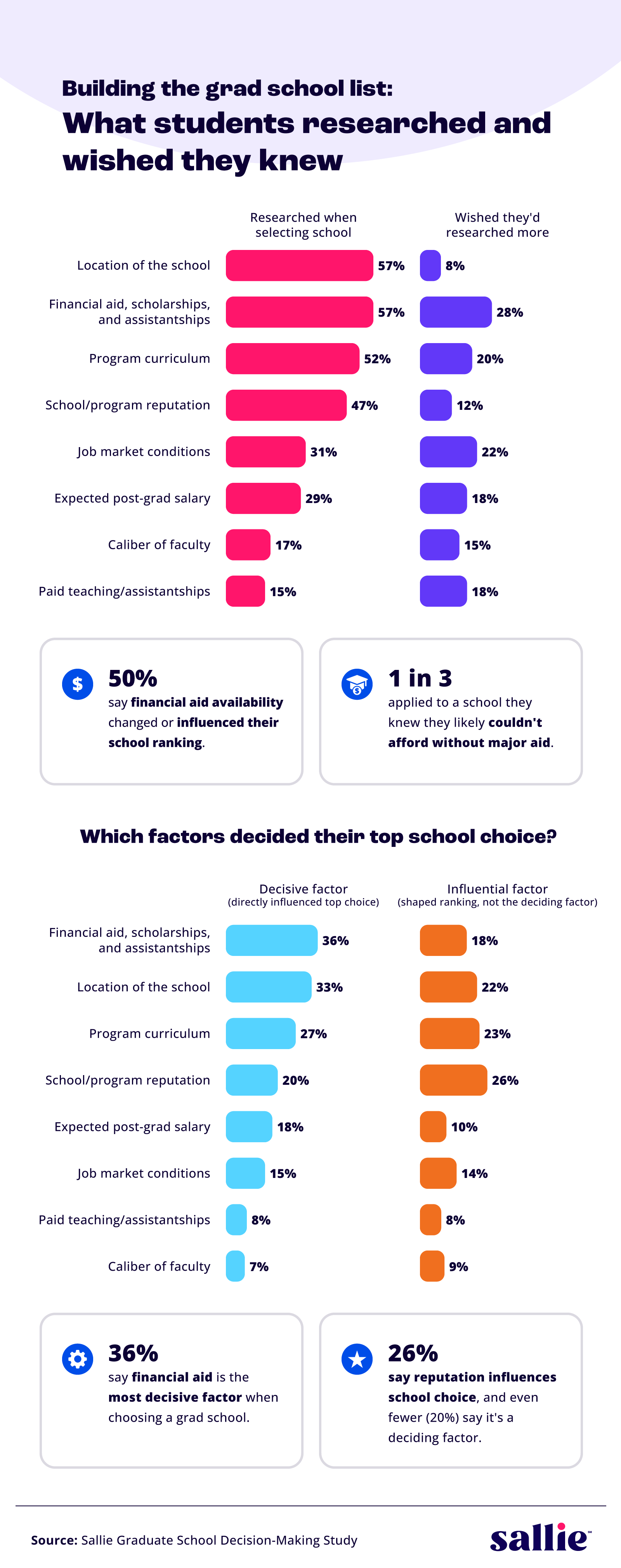
- The grad school decision is layered, with no single factor dominating. Financial aid, which includes scholarships, grants, and assistantships (36%), location (33%), and program curriculum (27%) are the three most decisive factors students point to when ranking their top school, with school reputation (20%), expected post-grad salary (18%), and job market conditions (15%) close behind. The picture shifts further when looking at influential factors that shaped students' rankings: school reputation jumps to 26%, program curriculum to 23%, and location to 22%.
- Personal context also played a role in how students chose their school. 33% of grad students say proximity to family influenced their school ranking, 29% cite cost of living in the area, and 22% point to amenities like restaurants, parks, and walkable streets. For many students, where they'll live matters as much as what they'll study.
- Most students do their homework on the basics. 57% researched school location and the same share looked into financial aid, assistantships, or scholarships when building their list, 52% looked into program curriculum, and 47% researched school or program reputation.
- The biggest research gaps show up in career planning. 1 in 5 graduate students wish they had done more research on career outcomes before finalizing their school list. Looking back, 28% wish they had researched financial aid, scholarships, or assistantships more, 22% wish they had dug deeper into job market conditions in their field (things like hiring demand and outlook for graduates with their degree), and 20% wish they had spent more time on program curriculum. These are the kinds of gaps that can push students away from their best-fit programs, even when they think they've done their research.
- Career outcomes deserve more upfront attention than students are currently giving them. Expected post-grad salary (18%) and job market conditions (15%) rank as decisive factors for far fewer students than aid or location, which is a gap worth noting. Considering career outcomes early on in the process may help students better understand how a program may support long-term goals and financial plans.
How financial aid fits into the decision
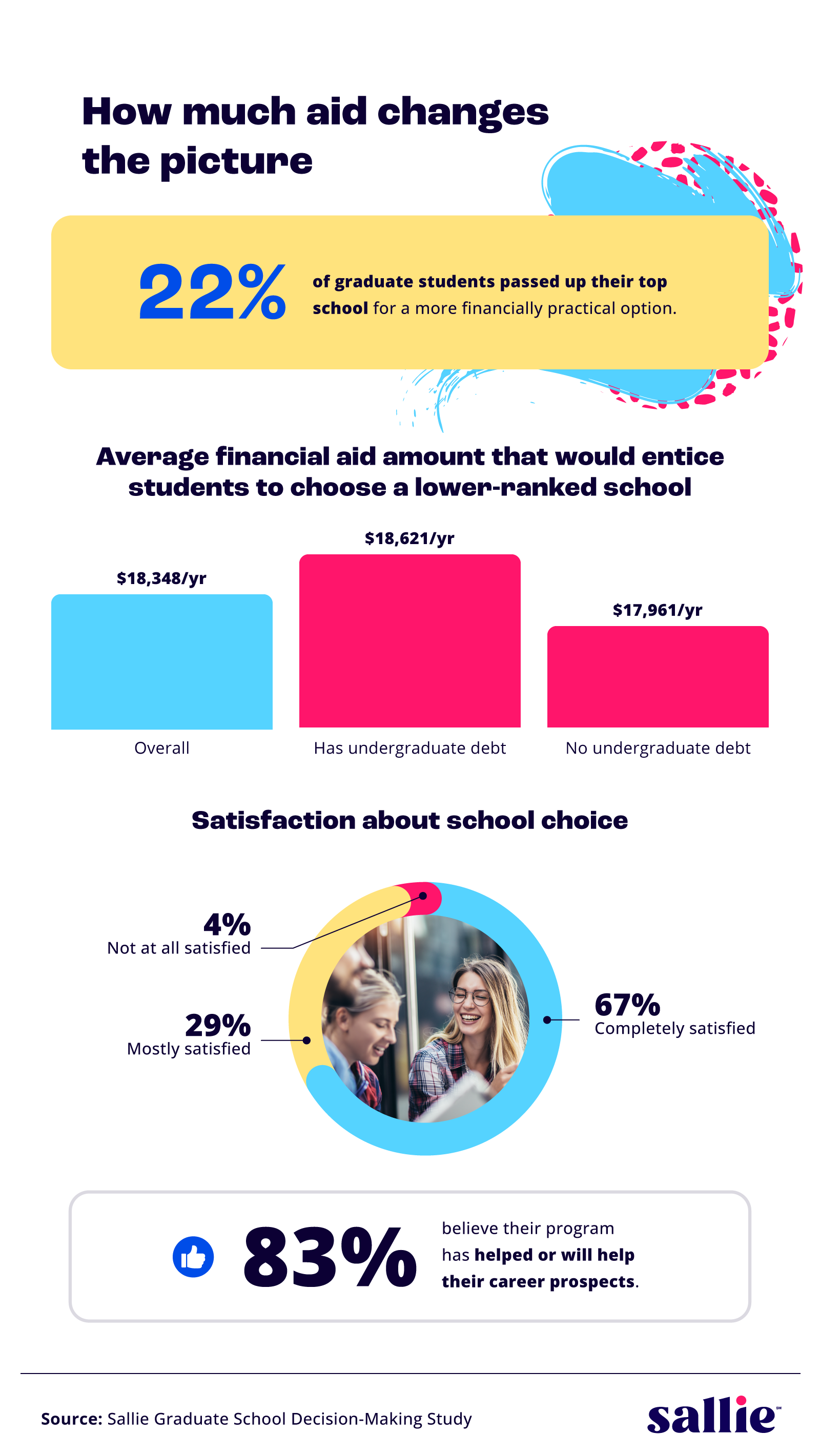
- Financial aid weighs heavily in students' final decisions, with 50% saying aid availability changed or influenced their school ranking, and 36% calling it the most decisive factor in their final pick. 1 in 3 students applied to a school they knew they likely couldn't afford without major aid, signaling that aid expectations shape the list itself.
- 77% of graduate students say the right financial aid offer would lead them to pick a more affordable program over a higher-ranked one. On average, an annual aid package of $18,348 would be enough to influence that decision. Students with undergraduate debt are slightly more responsive to aid ($18,621/yr), while those without undergraduate debt have a slightly lower threshold ($17,961/yr). 83% of students say $10,000 or more per year would be enough to flip their top choice.
- 67% of graduate students were satisfied with the school they chose, 29% were mostly satisfied, and 4% were unsatisfied. In fact, 83% of graduate students believe their program has helped or will help their career prospects (46% "definitely"; 37% "somewhat"), suggesting that even among students with some mixed feelings about school choice, most still see their degree paying off.
How to make a more confident grad school decision
A clear takeaway from this research is that the students who feel best about their grad school choice are the ones who research costs, explore aid options, and align their program with their career goals before they commit. Two smart moves to start with:
1. Understand costs and future earnings. Before you commit to a program, be clear on the total cost of attendance (not just tuition) and how that cost lines up with your career goals and earning potential. Knowing the full financial picture upfront makes it easier to evaluate whether a program is worth the investment.
2. Maximize free money. Grad scholarships, grants, fellowships, and assistantships can lower your overall grad school costs. Even smaller awards add up and reduce what you'd otherwise need to borrow. Consider using tools that streamline scholarship searches or help compare aid offers.
Free, trusted resources like Sallie can help with both, from applying for the $5,000 Grad School No Essay Scholarship and comparing financial aid offers to exploring grad programs with Scout. A little research now can mean fewer compromises (and more confidence) later.
Methodology
A survey conducted by Fractl on behalf of Sallie between March 30 and April 6, 2026, included 239 graduate school students; 59% were women, and 38% were men. Respondents included those currently enrolled in graduate programs (96) and those who graduated within the last 3 years (143). Master's degrees are the most common graduate degree pursued, with 195 respondents pursuing or having obtained one.
A few important clarifications on the findings:
On student outcomes and satisfaction: Data points related to satisfaction or financial tradeoffs reflect individual student perspectives and are not intended to assign responsibility to institutions for student disappointment or decision outcomes. Graduate school decisions involve complex personal, financial, and professional considerations that extend well beyond a program's control.
On graduate population diversity: This survey treats graduate and professional students as a single population for analytical purposes, which is a simplification. In reality, graduate programs vary significantly in structure, funding models, and available aid. Fine arts, social work, law, medicine, and other professional programs each operate under different financial frameworks, and findings may not apply equally across all program types.
On financial aid availability: Not all forms of financial aid are available to graduate and professional students. Certain aid types, including some grants and subsidized loan programs, are available only to undergraduate students. Options such as teaching assistantships and research assistantships exist in some programs but are not universally available. Students are encouraged to research the specific aid landscape for their program type.
About Sallie
Sallie is an education-solutions company that helps guide students and families through the entire higher-education journey with trusted tools, free-money-first support, and clear guidance from day one to done. Sallie helps students find scholarships, navigate financial aid, plan for college with Scout, and feel more confident about the steps ahead.
Fair use statement
The information in this article may be used for noncommercial purposes only. If you share it, please include a link and an attribution to Sallie.