-
Colleges
-
Graduate School
- Graduate School
- Scout Grad School Search Find and compare grad schools based on your preferences, goals and academic interests.
- $5,000 Grad School No Essay Scholarship† Enter to win our $5,000 no essay grad school scholarship in 2 min or less.
- Graduate Degrees Explore graduate degree options that fit your goals.
- Paying for Graduate School Understand costs and explore ways to pay for grad school.
-
Scholarships
- Scholarships
- $2,000 No Essay Scholarship† Enter to win our no essay $2,000 college scholarship in 2 minutes or less.
- Scholly Scholarships Easily find and sort through thousands of college scholarships for free.
- Scholarships for High School Seniors Explore scholarships for high school seniors and get tips on how to apply.
- Scholly Easy Apply Scholarships† Apply for up to $18,000 in scholarships each month with just one form.
- $5,000 Grad School No Essay Scholarship† Enter to win our $5,000 no essay grad school scholarship in 2 min or less.
-
Financial aid
- Financial Aid Grants, work-study, and federal student loans can all be part of your financial aid package.
- FAFSA® Guide Learn how to answer the 2027-28 FAFSA® questions like a pro.
- Financial Aid Offers Compare financial aid offers to determine the most affordable schools for you and your family.
- College Grants Learn more about federal and state grants and how to apply.
- Federal Pell Grants Discover what a Pell Grant is, who is eligible, and how to apply.
- Financial Aid Resources Get expert guidance on maximizing your financial aid options to make education more affordable.
-
Pay for School
- Sallie Mae® Student Loans
- Private Student Loans Find a private student loan designed to fit your needs.
- Undergrad Student Loan For college students earning a bachelor's or associate's degree.
- Graduate Student Loans Choose the right loan for your graduate degree or post-graduate studies.
- Career Training Loan For students taking professional training or certificate courses.
- Student Loan Resources Everything you need to navigate student loans with confidence.
.png?width=816&height=457&name=header-1920x1080%20(4).png)
Picking a major is a big decision, and plenty of students see it differently once the coursework gets real. Some stick with their choice, others make a change, and many wonder how that decision will affect the job they land. To see how that plays out, Sallie conducted a survey of 1,007 current undergraduates and recent graduates about how they chose their college major, what made them reconsider, and what happened after they made a change.
The responses map when second-guessing tends to start, which fields see the most students reconsider their path, whether switching pays off, and how AI is working its way into the decision. If you're weighing a change yourself, the patterns can help you time it and weigh the potential costs before you commit.
Key takeaways
- 2 in 3 students (66%) changed their major at least once, and nearly a quarter (24%) switched two or more times.
- Nearly half of students (47%) who second-guessed their major began questioning their choice in freshman year, about a year before most made the switch.
- More than half of students who kept their original major (53%) had seriously considered switching, but 61% of students who stuck with their original major were content with their choice.
- Switching tends to pay off, as 69% of students who changed majors feel more focused on their future and would make the same move again.
- The top reason students switch is passion over pay, with 44% changing to pursue a subject they care about more, well ahead of expected salary (19%).
- Nearly a third of students (32%) questioned their major because of AI, but only 3% actually switched over it.
When major doubt hits, and how many students act on it
Changing a major turns out to be closer to the norm than the exception, and the second-guessing usually starts sooner than the switch itself.
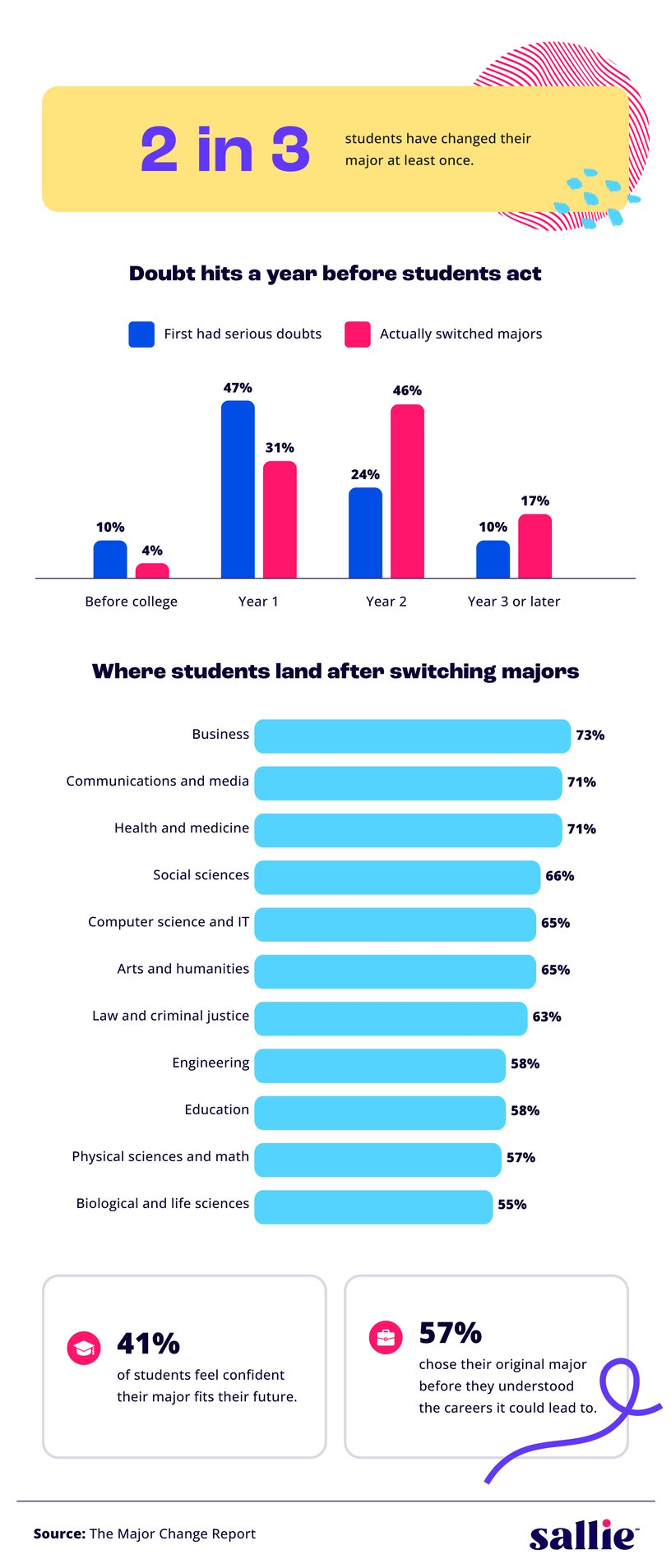
Among respondents, 2 in 3 students (66%) had switched at least once, and nearly a quarter (24%) had done it two or more times. The second-guessing usually starts early. Among students who doubted their major, 47% first felt it during freshman year, while most who switched didn't make the move until year two (46%), so doubt tends to run about a year ahead of action.
Even students who stayed weren't always certain. A majority of those who kept their original major (53%) seriously considered a change at some point, and for some, those doubts lingered. Nearly 2 in 5 students who never switched (39%) now say they wish they had. That uncertainty often started with the experience of the major itself. Among students who had doubts, 33% said they lost interest in the subject, while 28% found the coursework harder or more draining than expected. Another 21% struggled to picture their major leading to an actual job.
Major switchers are common across nearly every field. Nearly three-quarters of current business majors (73%) had changed majors at least once, as had 71% of students now studying communications and media or health and medicine. Even among fields with lower switching shares, more than half of students had changed course before landing there.
Major switching appears to have become less common across generations. While 72% of Gen X respondents changed majors during college, that share fell to 68% among millennials and 61% among Gen Z.
How it feels to switch majors
For the students who made the leap, the change tended to bring more focus and a clearer read on their prospects.
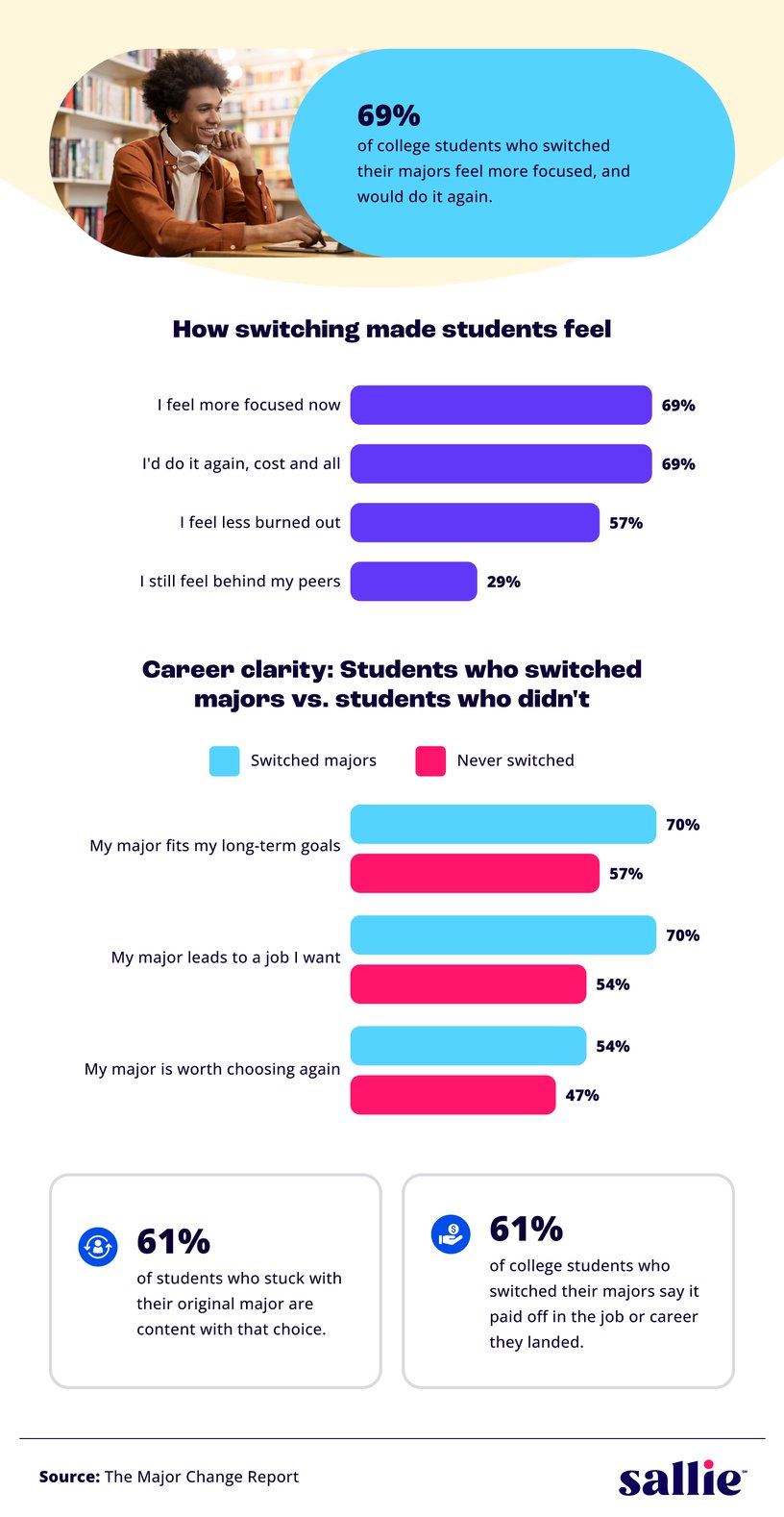
For most students, changing majors brought clarity. Nearly 7 in 10 of those who switched (69%) said they felt more focused on their future, and the same share would make the change again. That confidence carried into how they saw their prospects, with 70% believing their major would lead to a job they want, compared with 54% of students who didn't switch. Fit followed the same pattern, as 70% of students who switched felt their major matched their goals, versus 57% of those who never changed.
A majority of those who switched majors (61%) said the change paid off in the job or career they ultimately landed, and 42% said they'd changed mainly to improve their odds of getting hired. But changing course wasn't friction-free for all, as 29% of students who switched still felt a step behind their peers. For most, though, the trade felt worth it.
What triggers a college major change?
When students did switch, the pull of a better fit mattered more than any outside push.
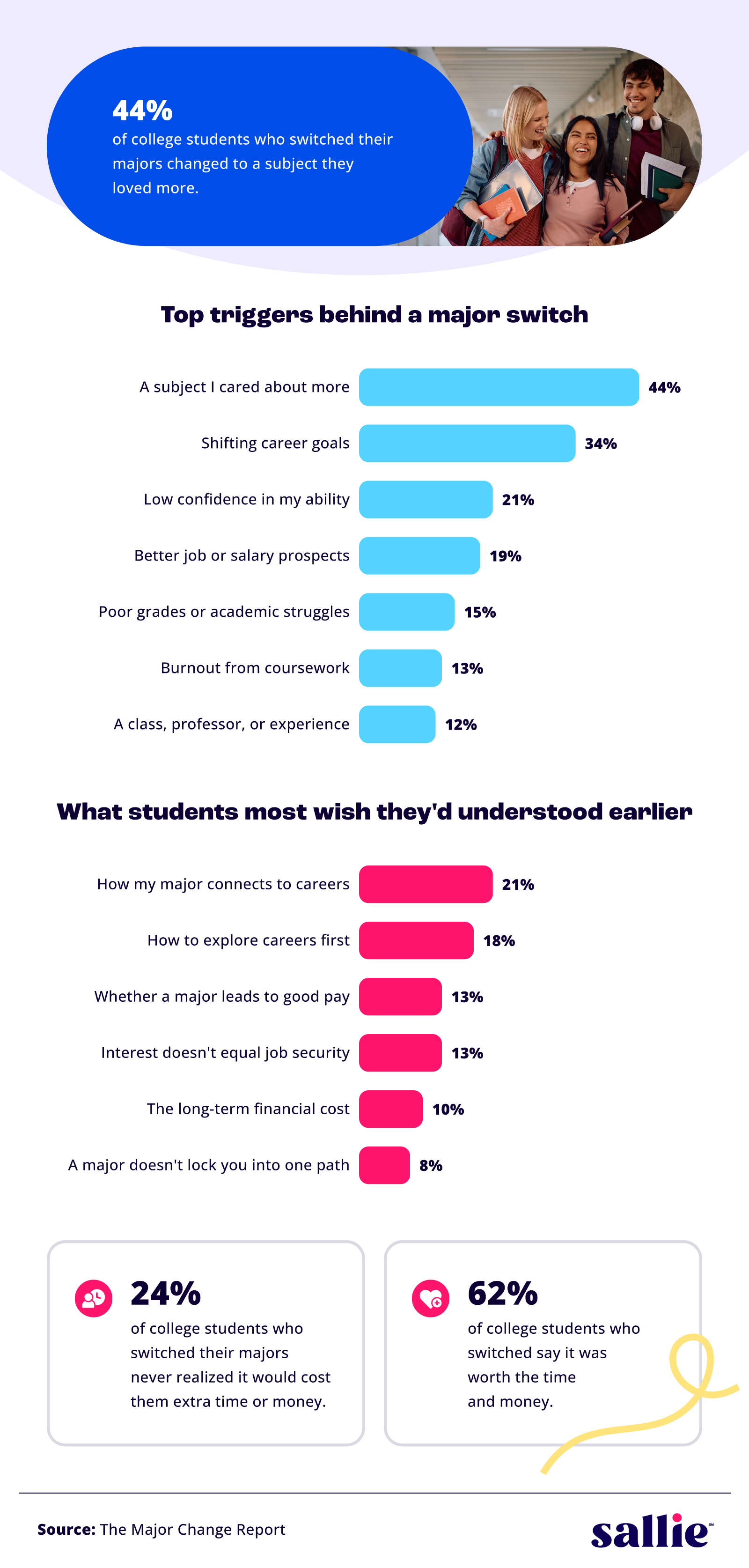
The biggest trigger among college students who switched their majors was finding a subject they cared about more (44%), well ahead of a bigger salary (19%) or family pressure (4%). Shifting career goals ranked second (34%).
Difficulty and fading interest also played a part for students who doubted their first major choice. A third said they'd lost interest in the subject, and 28% found the coursework harder than expected.
Timing is where a switch can get expensive. Nearly a quarter of students who switched (24%) hadn't realized the change would add any time or cost before they made it. Those who changed after year two added about two extra semesters, which can mean additional tuition and a later start to full-time earnings. If you're considering a change, factoring in the cost of extra terms and the potential earnings you could miss by graduating later can help you understand the full financial impact before making the switch.
About 21% of students said they wish they had understood sooner how different majors connect to specific career paths. Keeping career outcomes in mind from the start of a college search can help you choose a major that feels like a better long-term fit. Look at where graduates in different fields tend to work and which majors can lead to the careers that interest you most.
The AI major anxiety gap
AI has crept into how students judge their major, though it's shaping worry far more than it's changing plans.
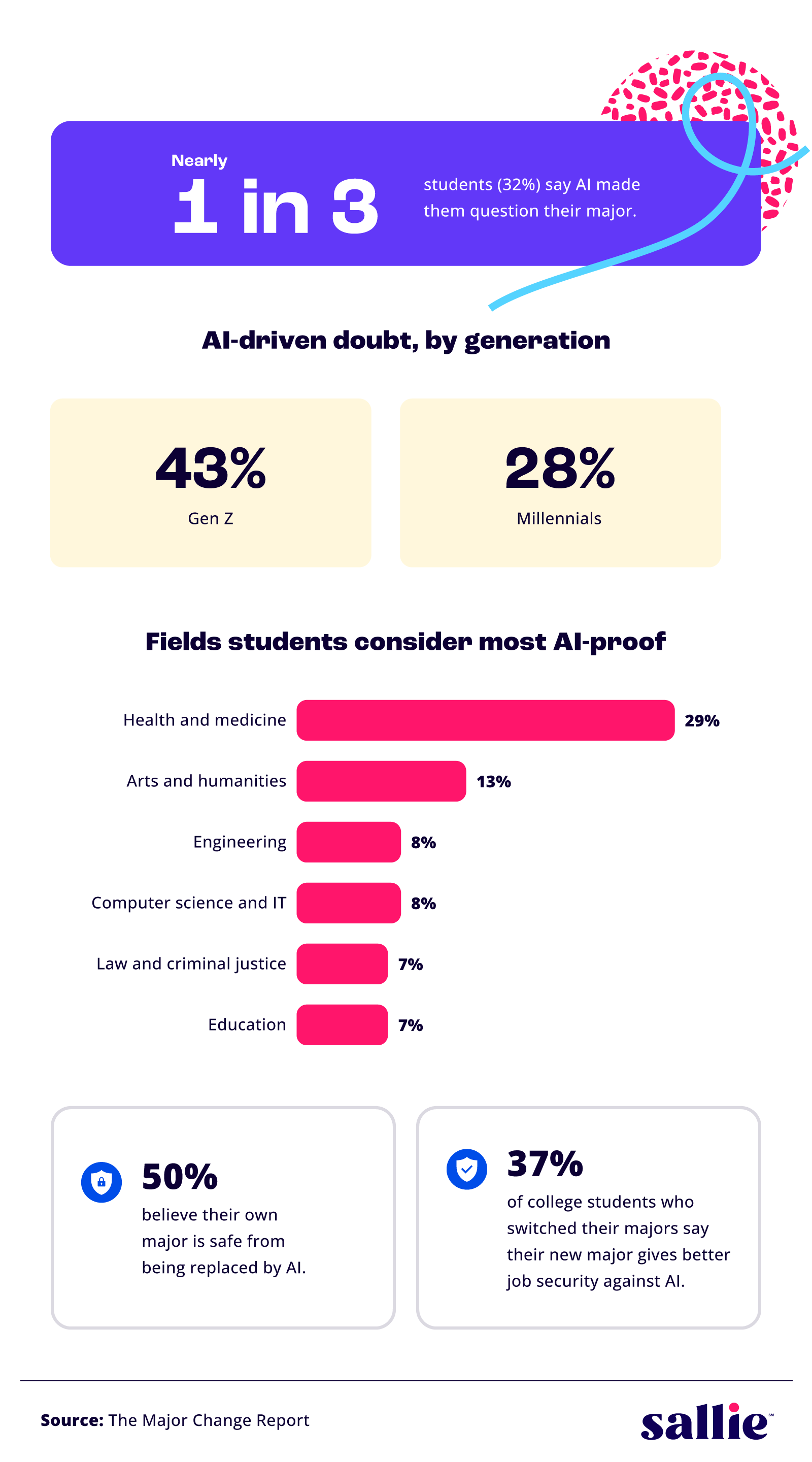
Nearly a third of students (32%) said AI made them question their major, yet only 3% actually switched because of it, and just 6% of students who doubted their major named AI as a reason. AI appears to be more of a consideration than a deciding factor, particularly for younger students. More than 2 in 5 Gen Z respondents (43%) said AI made them question their major, compared with 28% of millennials.
Most students still felt secure in what they chose. Half believed their own major is safe from being replaced by AI, and 37% of those who switched said their new major gave them better job security against it. When asked which fields feel most durable, students pointed to health and medicine again and again. Nearly 3 in 10 (29%) named it the most AI-proof field, more than double any other, while 42% called it the most recession-proof and 34% the most layoff-proof.
Making the change without losing ground
Changing a major is common, and for most students it leads to more focus and a clearer path to the work they want. The catch is timing and cost, since a later switch can add semesters and thousands in tuition. That's where a plan makes the difference, from understanding how a major connects to careers before you commit to lining up free money to cover any added time.
Starting with the outcome you want can make those decisions easier. Sallie's Scout College Search can help you compare schools and explore your options, while our guide to college majors can give you a clearer picture of where different fields may lead, including potential career and salary outcomes. If a change could add time or cost to your degree, Scholly Scholarships can also help you look for free money that may offset some of the expense.
The goal isn't to pick the "perfect" major on the first try. It's to make each decision with a better understanding of where it can take you and what it may cost to get there.
Methodology
A survey conducted by Fractl on behalf of Sallie in July 2026 surveyed 1,007 U.S. adults who were either currently enrolled as undergraduates or had graduated with an undergraduate degree within the past five years. Respondents were asked about their major-choice history, what drove any changes, how those changes turned out, and how forces like AI shape their confidence in their field of study.
The survey was fielded via CloudResearch Connect. Respondents ranged in age from 18 to 79, with an average age of 37. Ages were grouped into generations for analysis, with millennials making up the largest share at 45%, followed by Gen Z at 34%, Gen X at 17%, and baby boomers at 4%. The sample was 50% women, 48% men, and 2% non-binary or self-described. By enrollment, 81% had already graduated and 19% were currently enrolled. Just over half attended a public four-year school, and 27% were the first in their family to attend college.
Questions answered only by students who changed their major are based on that subgroup (669 respondents), and questions answered only by those who never changed are based on the remaining 338 respondents who kept their original major. Numeric responses were averaged both before and after removing statistical outliers using the interquartile range method. An attention-check question was included to ensure data quality, and figures throughout are rounded to the nearest whole percentage, so totals may not always sum to exactly 100%.
About Sallie
Sallie is an education-solutions company that helps guide students and families through the entire higher-education journey with trusted tools, free-money-first support, and clear guidance from day one to done. Sallie helps students find scholarships, navigate financial aid, consider colleges with Scout, and feel more confident about the steps ahead.
Fair use statement
We welcome the noncommercial reuse of this research and its assets. If you share these findings, please credit Sallie with a link back to this page so readers can view the full study and its methodology.