-
Colleges
-
Graduate School
- Graduate School
- Scout Grad School Search Find and compare grad schools based on your preferences, goals and academic interests.
- $5,000 Grad School No Essay Scholarship† Enter to win our $5,000 no essay grad school scholarship in 2 min or less.
- Graduate Degrees Explore graduate degree options that fit your goals.
- Paying for Graduate School Understand costs and explore ways to pay for grad school.
-
Scholarships
- Scholarships
- $2,000 No Essay Scholarship† Enter to win our no essay $2,000 college scholarship in 2 minutes or less.
- Scholly Scholarships Easily find and sort through thousands of college scholarships for free.
- Scholarships for High School Seniors Explore scholarships for high school seniors and get tips on how to apply.
- Scholly Easy Apply Scholarships† Apply for up to $18,000 in scholarships each month with just one form.
- $5,000 Grad School No Essay Scholarship† Enter to win our $5,000 no essay grad school scholarship in 2 min or less.
-
Financial aid
- Financial Aid Grants, work-study, and federal student loans can all be part of your financial aid package.
- FAFSA® Guide Learn how to answer the 2027-28 FAFSA® questions like a pro.
- Financial Aid Offers Compare financial aid offers to determine the most affordable schools for you and your family.
- College Grants Learn more about federal and state grants and how to apply.
- Federal Pell Grants Discover what a Pell Grant is, who is eligible, and how to apply.
- Financial Aid Resources Get expert guidance on maximizing your financial aid options to make education more affordable.
-
Pay for School
- Sallie Mae® Student Loans
- Private Student Loans Find a private student loan designed to fit your needs.
- Undergrad Student Loan For college students earning a bachelor's or associate's degree.
- Graduate Student Loans Choose the right loan for your graduate degree or post-graduate studies.
- Career Training Loan For students taking professional training or certificate courses.
- Student Loan Resources Everything you need to navigate student loans with confidence.

Writing a scholarship essay isn't just an academic exercise. For many students, it means deciding what parts of their lives to put on the page and often weighing whether their experiences feel "big enough" to compete. To better understand student perspectives, Sallie surveyed 503 U.S. students who have written scholarship application essays about what they share in their essays, how the writing process feels, and how essay requirements are affecting their scholarship search.
Essay pressure is real, and many students are stepping back from scholarships they may actually qualify for. The good news is that nearly 4 in 5 students say they would apply to more scholarships if more no-essay options were available, and those awards are more accessible than many realize. The essay can be a lot of work, but it also gives students a chance to tell their story, and there's a scholarship path for everyone, whether that means investing in an essay or exploring no-essay options.
Key takeaways
- Nearly 9 in 10 students who wrote scholarship essays (88%) say the essay requirement has led them to abandon, skip, or scale back their scholarship search.
- At the same time, about 3 in 5 students (59%) said they felt empowered while writing their scholarship essay.
- Nearly half of students (47%) chose not to apply to a scholarship because they thought their personal story wasn't dramatic or compelling enough.
- Over half of students (54%) have embellished or omitted details in a scholarship essay to seem more competitive.
- Nearly 4 in 5 students (78%) say they would apply to more scholarships if more no-essay awards were available, and about 1 in 5 (21%) had never heard of them before this survey.
The emotional side of the scholarship essay experience
- Over 9 in 10 students who wrote scholarship essays (92%) felt at least some pressure to share personal struggle, and 1 in 2 (47%) felt a lot or extreme pressure to do so.
- 50% of women and 40% of men in the survey felt a lot or extreme pressure to share personal struggle in their essays.
- Over 7 in 10 students (72%) have shared a personal hardship in their essay because they felt they had to in order to compete.
- Gen Z students felt the pressure to stand out more than millennials. About 3 in 5 Gen Z students (61%) shaped or adjusted details in their essay to be more competitive, compared to about 2 in 5 millennials (41%).
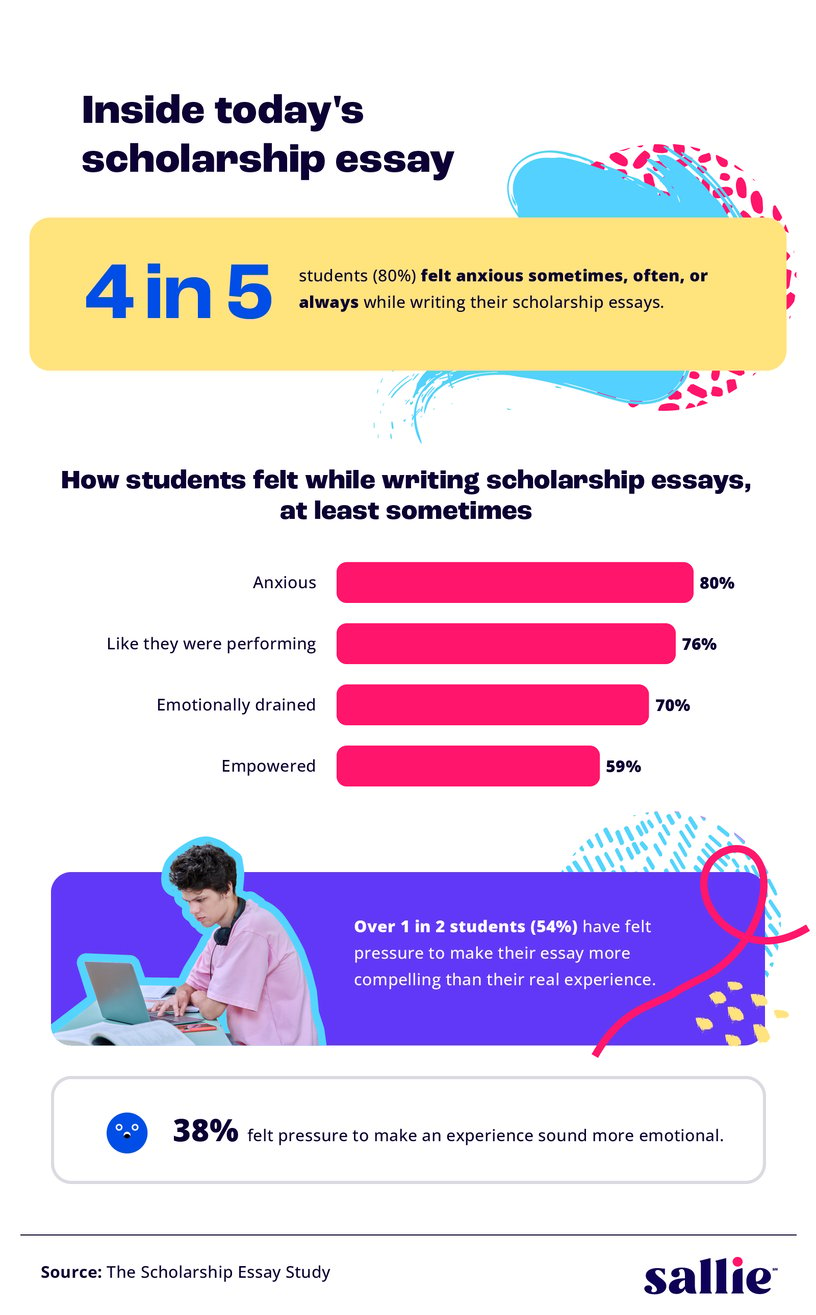
- 4 in 5 students (80%) felt anxious at least sometimes while writing, while 76% felt like they were performing, and 70% felt emotionally drained.
- Students value a range of qualities in a strong essay. When asked what scholarship essays reward most, about 3 in 10 (29%) pointed to authenticity, while others pointed to resilience, emotional intensity, or how compelling a story is (46% combined).
- About 3 in 5 students who wrote scholarship essays (59%) felt empowered at least sometimes while writing, and a similar share (58%) found the process cathartic. For many students, the essay is demanding work that also offers a chance to reflect and tell their own story.
- Over 1 in 2 students (57%) worried their experiences weren't compelling enough for what they thought the essay needed.
How essay requirements affect scholarship searches
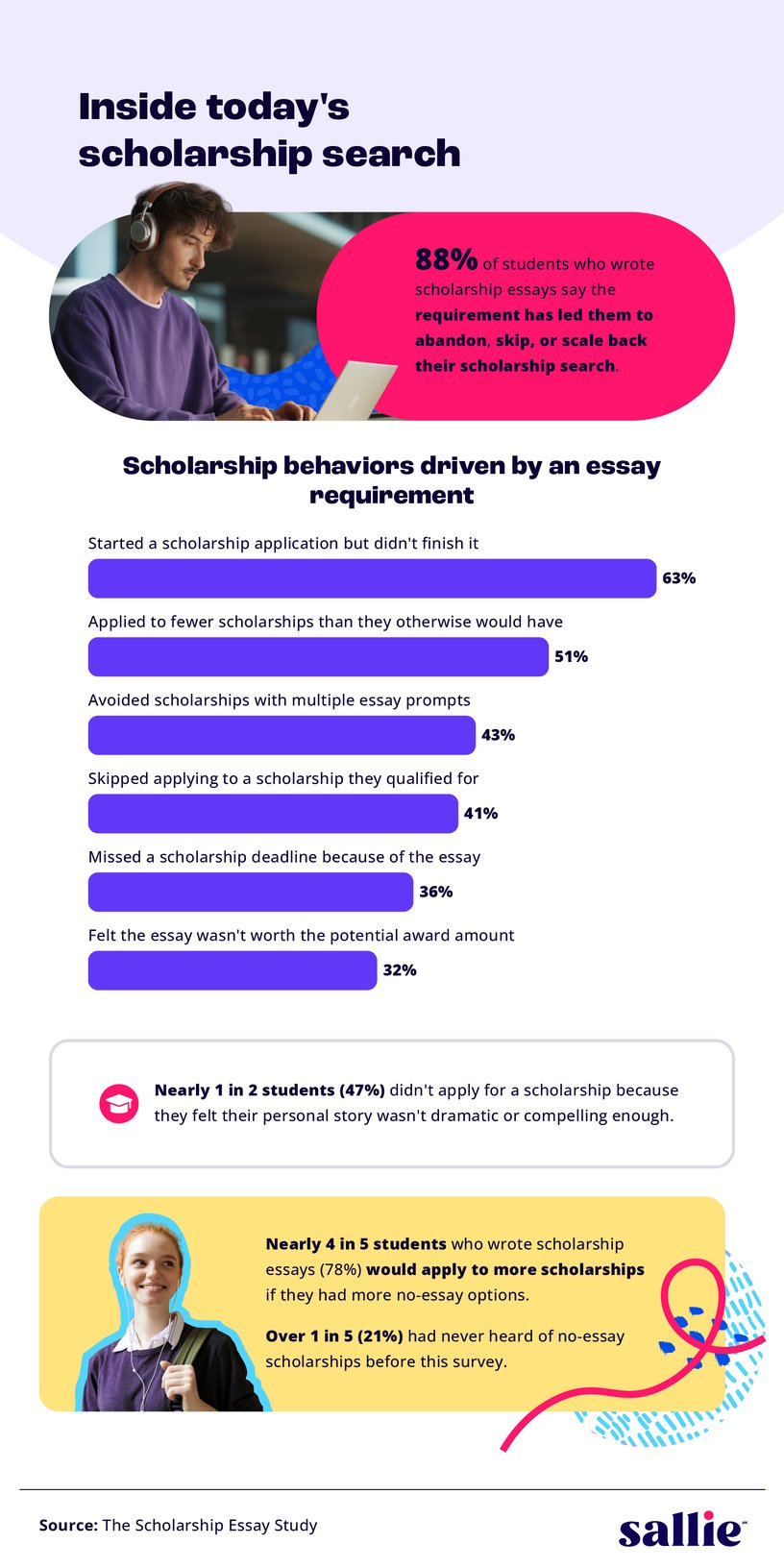
- Over 3 in 4 students (77%) either didn't apply (47%) or considered not applying (30%) because they didn't think their story was compelling enough.
- Gen Z students are more likely than millennials to scale back their search. About 9 in 10 Gen Z students (91%) say the essay requirement led them to abandon, skip, or scale back, compared to 4 in 5 millennials (80%).
- 51% of women and 41% of men in the survey didn't apply to a scholarship because their story wasn't compelling enough.
- More no-essay options are the No. 1 scholarship application change students want, with 2 in 5 students (40%) selecting "more no-essay options" as their top requested change.
- Many students don't know no-essay scholarships exist. Nearly 4 in 5 (78%) would apply to more with no-essay options, yet about 1 in 5 (21%) had never heard of them before this survey.
Finding scholarships that fit your story
If the essay process feels like a lot, that's totally understandable, but the scholarship world is bigger than essay-based awards. Here are a few ways to take some of that pressure off:
- Start with no-essay scholarships. With 40% of students saying they want more no-essay options, it's worth beginning your search here. The Sallie $2,000 No Essay Scholarship takes only a few minutes to enter, and there are plenty of other no-essay awards out there worth looking into.
- Or lean into the essay if you want to tell your story. For students who want to feel they've earned the opportunity, essay-based scholarships can be rewarding. A few tips can make the writing feel more manageable. Sallie's guide to scholarship essays is a good place to start.
- Apply early and often. Students who do well tend to treat scholarships as a steady habit rather than one high-stakes essay. Smaller awards add up, and the more you apply for, the less weight any single application carries.
- Let a tool do the matching. Finding awards that fit you is easier when you're not searching blind. Scholly Scholarships can filter by your academic interests, background, location, and more, so you can find scholarships built around your strengths.
The right scholarships are out there, and Sallie can help you find them.
Methodology
Sallie surveyed 503 U.S. scholarship essay writers in 2026, including students who have completed at least one scholarship essay during their academic journey. The gender breakdown was 62% women, 35% men, and 2% non-binary or prefer not to say. Generations represented include Gen Z (71%), millennials (25%), Gen X (4%), and baby boomers (less than 1%), with a median age of 24 years. Respondents attended a mix of institutions, including public four-year universities (58%), community colleges (17%), private four-year universities (16%), online universities (7%), trade or vocational schools (1%), and other types of institutions (1%).
About Sallie
Sallie is an education-solutions company that helps guide students and families through the entire higher-education journey with trusted tools, free-money-first support, and clear guidance from day one to done. Sallie helps students find scholarships, navigate financial aid, plan for college with Scout, and feel more confident about the steps ahead.
Fair use statement
The information in this article may be used for noncommercial purposes only. If you share it, please include a link and an attribution to Sallie.