-
Colleges
-
Graduate School
- Graduate School
- Scout Grad School Search Find and compare grad schools based on your preferences, goals and academic interests.
- $5,000 Grad School No Essay Scholarship† Enter to win our $5,000 no essay grad school scholarship in 2 min or less.
- Graduate Degrees Explore graduate degree options that fit your goals.
- Paying for Graduate School Understand costs and explore ways to pay for grad school.
-
Scholarships
- Scholarships
- $2,000 No Essay Scholarship† Enter to win our no essay $2,000 college scholarship in 2 minutes or less.
- Scholly Scholarships Easily find and sort through thousands of college scholarships for free.
- Scholarships for High School Seniors Explore scholarships for high school seniors and get tips on how to apply.
- Scholly Easy Apply Scholarships† Apply for up to $18,000 in scholarships each month with just one form.
- $5,000 Grad School No Essay Scholarship† Enter to win our $5,000 no essay grad school scholarship in 2 min or less.
-
Financial aid
- Financial Aid Grants, work-study, and federal student loans can all be part of your financial aid package.
- FAFSA® Guide Learn how to answer the 2027-28 FAFSA® questions like a pro.
- Financial Aid Offers Compare financial aid offers to determine the most affordable schools for you and your family.
- College Grants Learn more about federal and state grants and how to apply.
- Federal Pell Grants Discover what a Pell Grant is, who is eligible, and how to apply.
- Financial Aid Resources Get expert guidance on maximizing your financial aid options to make education more affordable.
-
Pay for School
- Sallie Mae® Student Loans
- Private Student Loans Find a private student loan designed to fit your needs.
- Undergrad Student Loan For college students earning a bachelor's or associate's degree.
- Graduate Student Loans Choose the right loan for your graduate degree or post-graduate studies.
- Career Training Loan For students taking professional training or certificate courses.
- Student Loan Resources Everything you need to navigate student loans with confidence.

Ask anyone a few years past their first semester what advice they would give to incoming college freshmen, and it’s rarely about grades. The advice tends to be more about pacing yourself, building good study habits, and asking for help, the kind of thing that's easy to see clearly only in hindsight.
Sallie's Freshman Advice Report, a survey of 529 current college students and recent graduates, asked what they most wish they'd known before freshman year of college, including the habits worth building early, the campus resources worth using sooner, and how AI is changing the guidance they'd give. Their answers add up to a practical playbook for students just starting out.
Key takeaways
- Students most wish they'd taken study habits and time management (19%), internships/networking (16%), and mental health (13%) more seriously earlier in freshman year.
- More than 9 in 10 college students (93%) say they spent freshman-year energy worrying about something that didn't end up mattering.
- Most college students (62%) would still choose the same major, even with emerging AI as a factor in the job market.
- The advice students would most pass on to incoming freshmen: build strong study habits early (51%), give yourself time to adjust to college life (49%), and protect your mental health from day one (37%).
- Students say the best way for today's freshmen to stay ahead of AI is to strengthen the human skills it can't replace (47%), like communication, judgment, and leadership.
The advice students would pass down to the next class of freshmen
Asked what advice they'd give an incoming freshman, students pointed less to acing exams and more to habits, pacing, and looking after themselves.
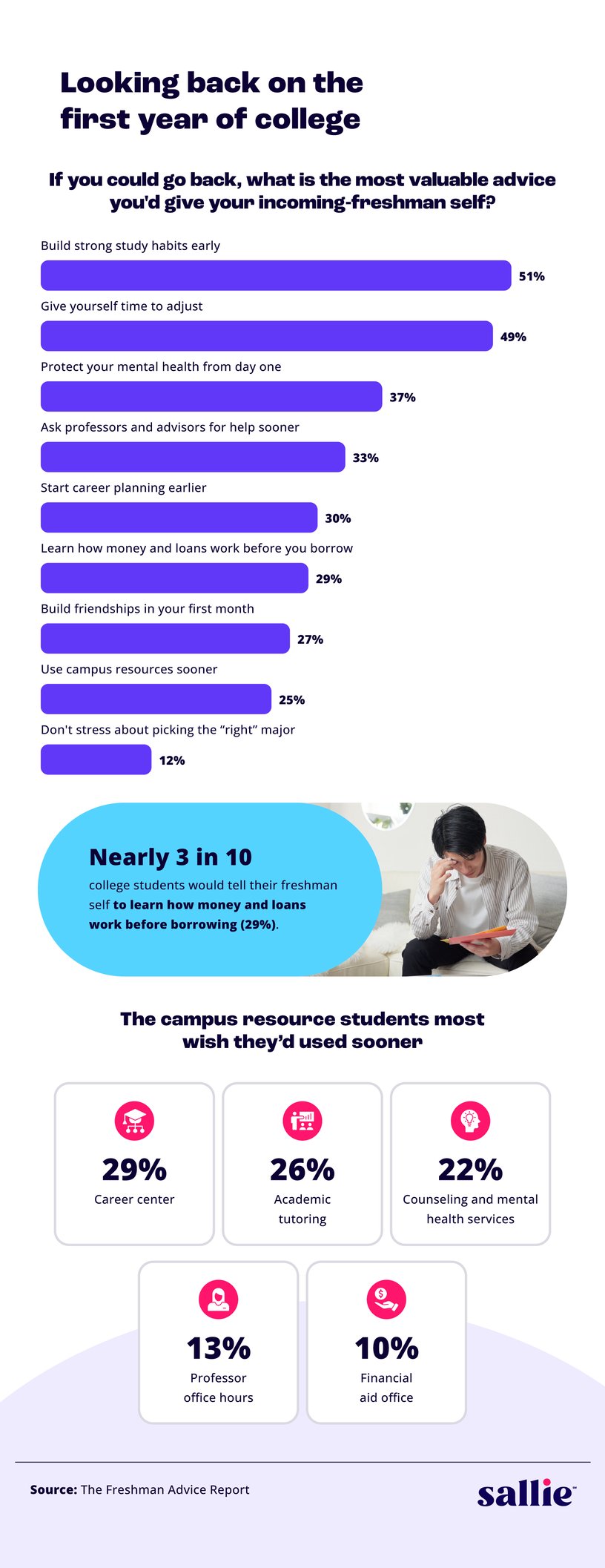
The advice students returned to most often had nothing to do with grades and everything to do with habits, headspace, and giving themselves room to grow. Asking professors and advisors for help sooner (33%) and starting career planning earlier (30%) rounded out the most common advice.
Students also named the campus resources they wish they'd used sooner. The career center led the way (29%), ahead of academic tutoring (26%) and counseling and mental health services (22%).
The advice shifted depending on who was giving it:
- Gen Z students were more than twice as likely as millennials to wish they'd built friendships in their first month (31% vs. 14%).
- Gen Z students were more likely than millennials to wish they had used the career center sooner (31% vs. 21%).
Most freshman-year worries turned out not to matter
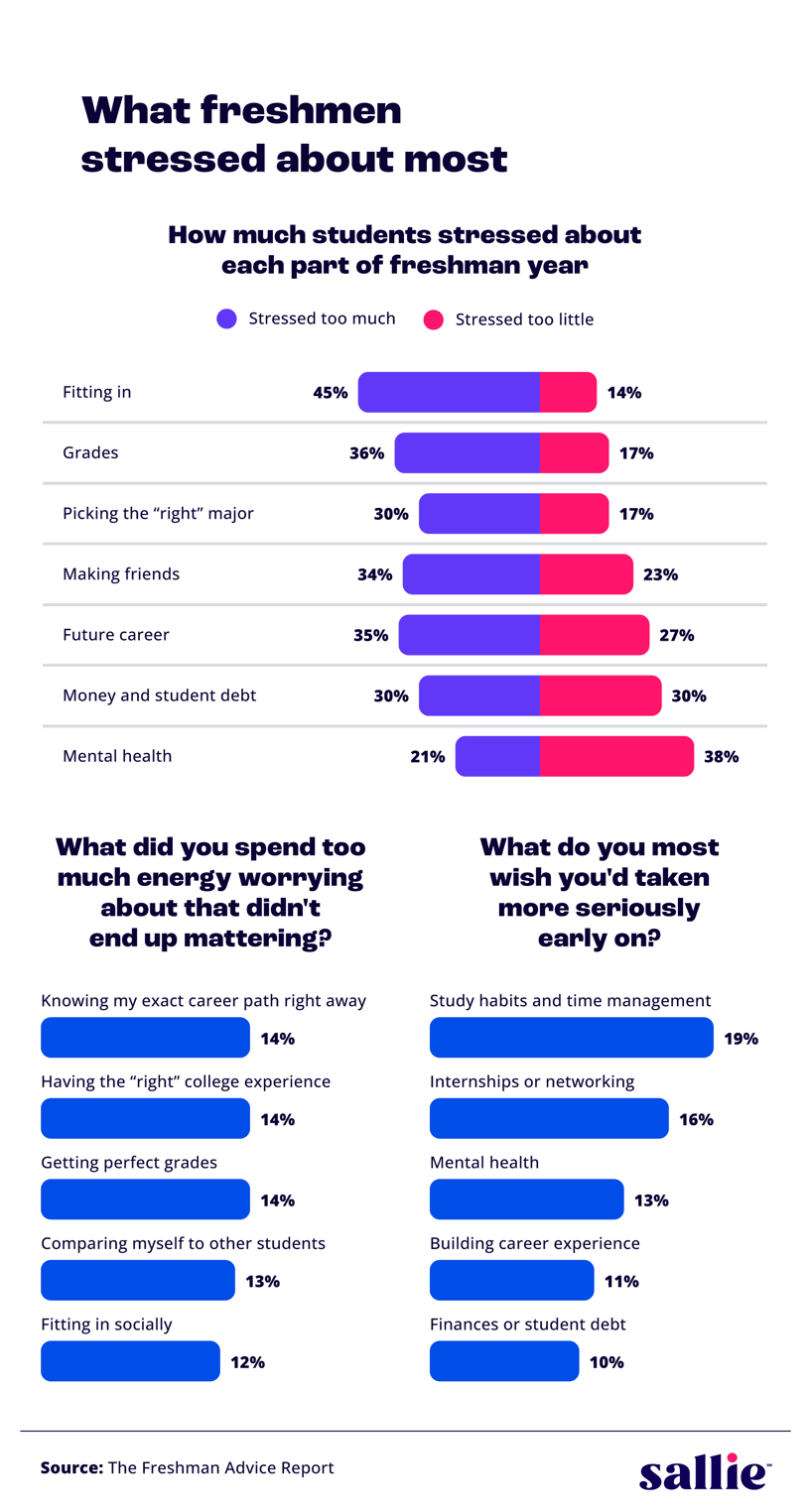
More than 9 in 10 students (93%) named something they worried about too much that didn't end up mattering. Fitting in was the most common thing students worried too much about, with 45% saying they fretted about it too much, ahead of grades (36%) and picking the "right" major (30%). Mental health ran the other way, with 38% saying they worried about it too little.
When students named where they spent the most energy that didn't pay off, it was the big, abstract pressures:
- Knowing their exact career path right away (14%)
- Having the "right" college experience (14%)
- Getting perfect grades (14%)
Hindsight also affected what felt important. The things students most wish they'd taken more seriously were study habits and time management (19%), internships or networking (16%), and mental health (13%).
Millennials were more than twice as likely as Gen Z to wish they'd taken study habits more seriously (32% vs. 15%), while Gen Z were nearly three times as likely to wish they'd pursued internships or networking (19% vs. 7%).
AI is shifting how students think about their major and skills, but less than you might expect
When asked whether AI changes the advice they'd give, students said it factors in, though less than you might expect.
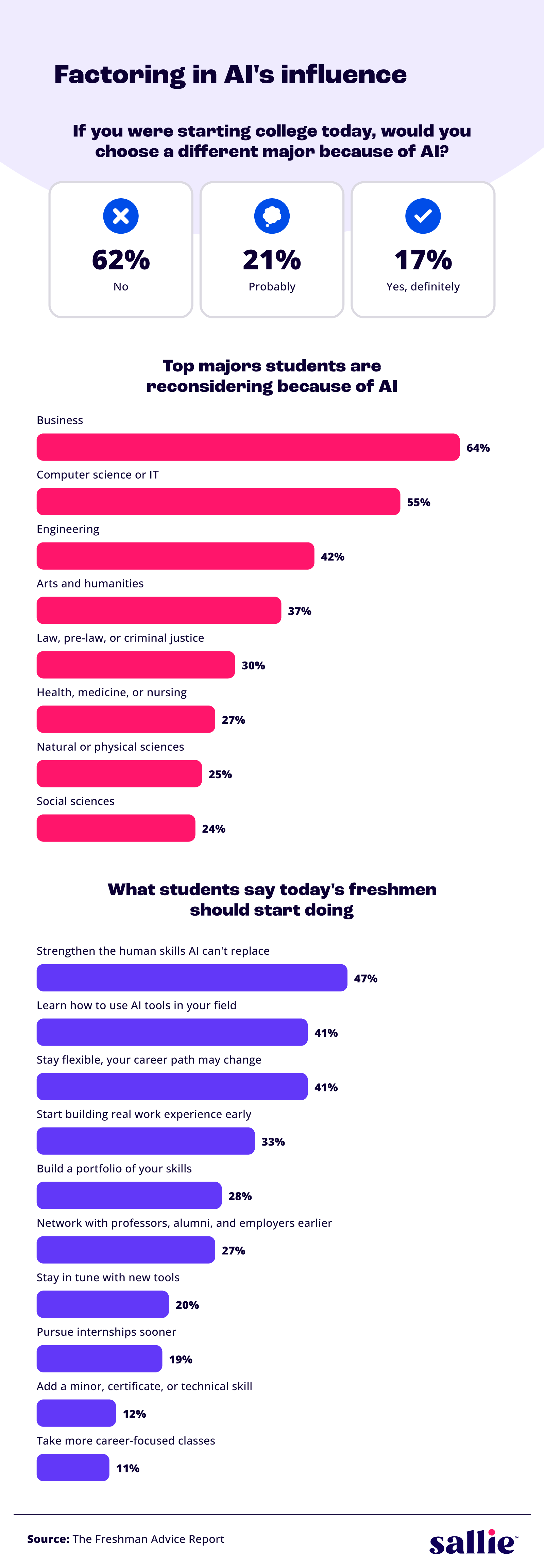
Even with AI's influence, most students (62%) said they'd still choose the same major if they had to do so all over again. About 1 in 5 (21%) said they would probably switch, and 17% would definitely switch. Among those rethinking their path, business (64%) and computer science or IT (55%) topped the list of majors students said they'd reconsider.
Asked how today's freshmen should prepare, students most often suggested:
- Strengthening the human skills AI can't replace (47%)
- Learning to use AI tools in their field (41%)
- Staying flexible as career paths shift (41%)
- Building real-world work experience early (33%)
The preparation students valued most from their college was hands-on, real-world work experience (33%), just ahead of learning how to use AI tools (27%).
Generations split on what matters most. Millennials leaned toward learning AI tools (54% vs. 38% of Gen Z), while Gen Z was far more likely than millennials to say freshmen should pursue internships sooner (22% vs. 6%).
What this year's freshmen can borrow from the class ahead
The throughline across the data is reassurance. Students who've already been through freshman year would tell you that you don’t need it all figured out right away. Ease up on the pressure to be perfect and focus instead on the fundamentals that actually carry you: building good habits, protecting your mental health and giving yourself room to adjust. That advice held up even with emerging AI as a factor, with students still pointing to real-world experience and a willingness to ask for help before anything else.
If you're heading into your first year, consider the advice of the people who just walked the same path, and lean on the resources built to help you. Sallie can guide your next step, from finding scholarships for college freshmen to searching thousands of awards for free with Scholly Scholarships and choosing the right school fit with Scout College Search.
Methodology
A survey conducted by Fractl on behalf of Sallie in 2026 polled 529 U.S. current college students and recent graduates about the advice they wish they'd received before their freshman year. Respondents were asked about the lessons they most wish they'd followed, the campus resources they wish they'd used sooner, the guidance they received on student loans, what they worried about too much or too little, and how AI is changing their views on choosing a major, building skills, and preparing for the job market. The gender breakdown was 54% women, 43% men, and 3% non-binary. Generations represented include Gen Z (78%), millennials (18%), and Gen X (4%), with a mean age of 26 years.
About Sallie
Sallie is an education-solutions company that helps guide students and families through the entire higher-education journey with trusted tools, free-money-first support, and clear guidance from day one to done. Sallie helps students find scholarships, navigate financial aid, plan for college with Scout, and feel more confident about the steps ahead.
Fair use statement
The information in this article may be used for noncommercial purposes only. If you share it, please include a link and an attribution to Sallie.